About this article
Nothing replaces Varanasi. That isn't the point.
Varanasi is the spiritual capital of India, and it is older than almost anything we can date. Older than most of the traditions practised inside it. It belongs to Shiva, and it has belonged to him for so long that the city has stopped being a place where people worship him and become something closer to a body he inhabits. The streets are not laid out for traffic. They are laid out as a mandala — sacred circuits, ring roads of pilgrimage, the whole city built as a single temple with the Ganges as its floor. Fires at Manikarnika have not gone out in living memory. To die here is to be released. No other city on earth does what Varanasi does, and no other city is trying to.
So this is not a list of replacements.
But there is a real thing that happens to travellers who have already been. You come home changed and slightly wrung out, and a year or two later you want India again — and you find that going back to Varanasi would be repeating a sentence rather than saying a new one. There is also a second group: people who read about Varanasi honestly, including our own first-timer's guide to the city, and decide that open cremation grounds and 4 a.m. alleyways are not how they want to meet India for the first time.
Both of you should go south.
South India kept something the north lost to invasion and reconstruction: temple cities that were never broken. Not ruins, not restorations — enormous working complexes, some of them a thousand years old, still running the same daily rituals, still surrounded by the streets that were planned around them. The register is completely different. Where Varanasi is intimate, narrow and improvised, the South is geometric and monumental. Granite instead of riverbank. Gopurams instead of ghats. Where Varanasi asks you to sit with mortality, these cities ask you to look up.
Here are eight of them, laid out north to south the way you would actually travel them.
1. Hampi, Karnataka — an empire left out in the sun
Hampi is the strangest landscape on this list and the only one that is no longer a city. For two centuries it was the capital of the Vijayanagara Empire — by some accounts one of the largest cities in the world in the 1500s — and then it was sacked and abandoned, and the jungle and the boulders took it back.
What survives is spread across roughly 4,100 hectares of granite outcrops the colour of old bread, stacked in formations that look deliberately balanced. Temple complexes, market streets, elephant stables, aqueducts and royal enclosures sit among them with no city left in between. It is a UNESCO World Heritage Site, and it is one of the few places in India where you spend the day walking rather than queuing.
Three things anchor a visit. Virupaksha Temple is still an active shrine, still doing daily puja after all this time, which gives Hampi a pulse the rest of the ruins don't have. Vittala Temple holds the stone chariot that ended up on the ₹50 note, and the colonnade of musical pillars that ring at different pitches when struck — you can no longer strike them yourself, and shouldn't try. And Matanga Hill at sunrise or sunset is the view that makes people stay an extra day: the whole boulder field going gold, the Tungabhadra threading through it.
Do the coracle crossing on the river. Give the site three days if you can; two feels rushed and one is a mistake, because the monuments are further apart than the map suggests and there is almost no shade anywhere.
One honest note: the Virupaksha temple elephant is a fixture that international visitors react to very differently. Some find it moving, others uncomfortable. Go in knowing it's there.
Best paired with: Belur and Halebidu, four to five hours south by road.
2. Belur & Halebidu, Karnataka — carving at the scale of jewellery
These two towns sit about sixteen kilometres apart near Hassan, and they are always done together. They were the twin capitals of the Hoysala dynasty, and what the Hoysalas did with stone has no real parallel anywhere else in India.
The trick was the material. Instead of granite, they carved chloritic schist — soapstone — which is soft when quarried and hardens on exposure. That let their sculptors work like goldsmiths. At Chennakeshava Temple in Belur and Hoysaleshwara Temple in Halebidu, you can stand a foot from a wall panel and pick out individual bangles on a dancer's wrist, the weave of a fabric, the strands in a braid, the claws of an animal in a hunting frieze. Entire chapters of the Ramayana and Mahabharata run around the plinths in bands, readable panel by panel. The Sacred Ensembles of the Hoysalas were inscribed by UNESCO in 2023.
The scale is the opposite of the Tamil temple cities — these are single buildings on star-shaped platforms, not walled towns, and you can see all of both in a full day.
The contrast between them is worth knowing before you arrive. Chennakeshava at Belur is still in active worship, so you get incense, bells, a queue, a living building. Hoysaleshwara at Halebidu is a protected monument and no longer functions as a temple, so it is quieter, emptier and more museum-like. Travellers who visit Halebidu after a week in Tamil Nadu sometimes find it strangely flat for exactly this reason. Visit Halebidu first and Belur second if you can.
You will need a car; public transport between the two is possible but tedious. ASI-licensed guides here get consistently good reviews and are genuinely worth hiring — half of what makes these walls extraordinary is invisible until someone points at it.
Both Hampi and the Hoysala towns sit on our 20-day Karnataka Spiritual Tour — Sacred Shrines, Mountains & Coastline, which is currently the only guided route that covers all four of Belur, Halebidu, Hampi and Badami.
3. Kanchipuram, Tamil Nadu — the city of a thousand temples, and a loom in every second street
Kanchipuram is one of the seven cities Hinduism considers sacred enough to grant liberation, and it is the only one of the seven in the south. It was a Pallava capital, then a Chola city, then a Vijayanagara one, and each dynasty left temples behind, which is how it ended up with the "thousand temples" reputation. The working figure today is a couple of hundred active shrines inside the town.
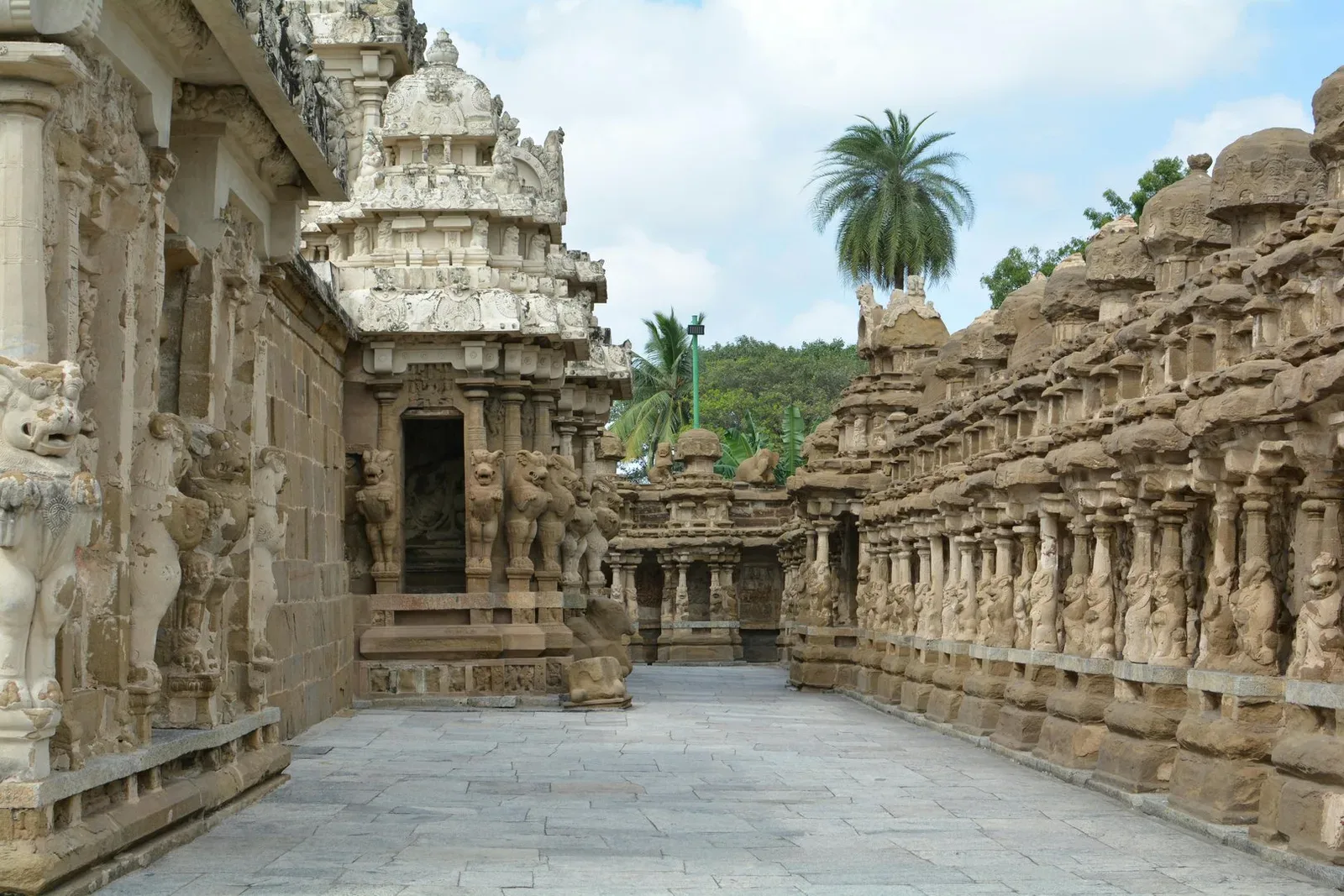
You cannot see them all and you shouldn't try. Three or four is a good day.
Kailasanathar Temple is the one to lead with. Built by the Pallavas in the early 8th century out of sandstone, before the Tamil style hardened into the granite-and-gopuram formula, it is low, weathered, honey-coloured and almost always quiet. There are small chambers around the inner wall you can walk through. After a week of vast crowded complexes it feels like sitting down.
Kamakshi Amman Temple is the opposite — one of the major goddess shrines of the south, busy, gilded, central to the town's life. Kanchipuram's other great temple, Ekambareswarar, is the Earth shrine of the five element temples; we cover it properly in our guide to the Pancha Bhuta Stalam rather than repeating it here.
Then there is the silk. Kanchipuram saris are woven here in workshops you can walk into, and watching a weaver work a zari border on a pit loom — a single sari can take weeks — is one of the better hours you'll spend in Tamil Nadu. Buy from a weavers' cooperative rather than a shop your driver recommends.
It's roughly 75 km from Chennai, which makes it the easiest entry point on this entire list if you're flying into Chennai rather than Bengaluru.
4. Tiruvannamalai, Tamil Nadu — the mountain that is the god
Tiruvannamalai is the odd one out, and it earns its place. The subject here is not really the temple — though Annamalaiyar Temple is enormous, one of the largest in India, with a gopuram you can see from far out on the plain. The subject is the hill behind it. Arunachala is not a hill with a temple on it. In this tradition the hill is Shiva, in the form of fire, and pilgrims walk the fourteen-kilometre road around its base — the Girivalam — barefoot, most powerfully on full moon nights.
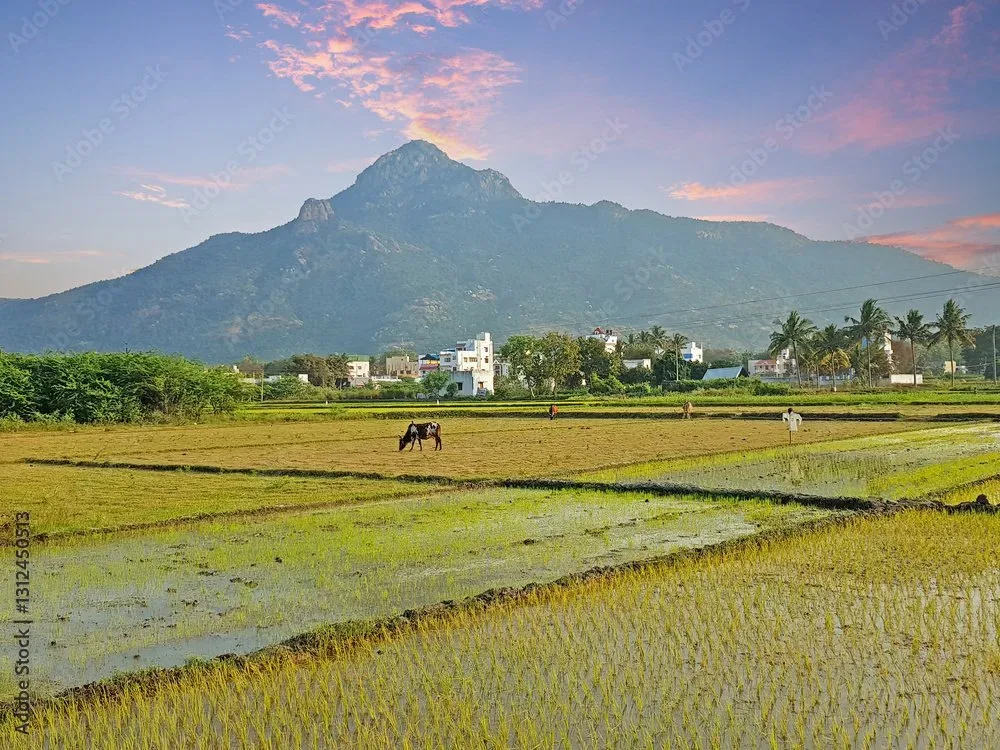
It is also where Ramana Maharshi lived and taught, which has made the town a permanent gathering point for seekers of self-inquiry from all over the world. The mix of ancient Tamil temple ritual and international meditation community is unlike anywhere else on this route.
We've written about this town twice already: why Tiruvannamalai draws Vedanta seekers, and a practical rundown of the Girivalam walk, Arunachala's caves and the ashrams around the hill.
If you'd rather go deep in one place than cover a circuit, The Silent Guru — Arunachala & Tiruvannamalai is six days in this town alone. Kanchipuram and Tiruvannamalai also sit together on Discovering Shiva, a ten-day journey through the five element temples with a maximum of twelve participants.
5. Thanjavur, Tamil Nadu — the one that shouldn't be standing
The Brihadisvara Temple was finished in 1010 CE by Raja Raja Chola I, built entirely of granite hauled from tens of kilometres away, crowned by a 66-metre vimana topped with a single capstone weighing around 80 tonnes. There were no cranes. There was no mortar. It has been standing for over a thousand years in an active earthquake-tolerant configuration that engineers still write papers about, and it remains a working temple, not a monument.
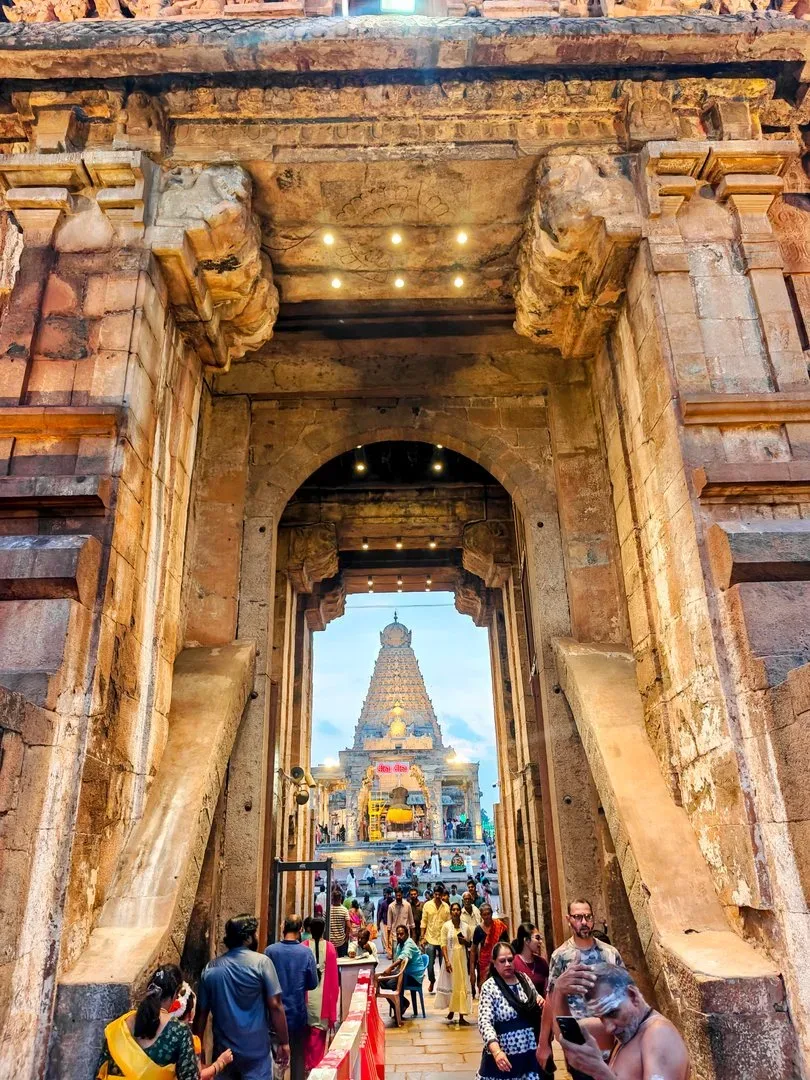
Go at sunrise, when the granite is pink and the courtyard is nearly empty.
We've given this temple its own full guide — timings, entry, what to look for inside, the Chola history, and how it fits a wider itinerary — in the complete guide to Brihadisvara Temple, Thanjavur.
6. Srirangam, Tamil Nadu — a city inside a temple
Srirangam is an island in the Kaveri, inside the city of Trichy, and the whole island is essentially one temple. Sri Ranganathaswamy is the largest functioning Hindu temple complex in the world: seven concentric walled enclosures, twenty-one gopurams, the outermost Rajagopuram rising around 72 metres, the tallest temple tower in India.
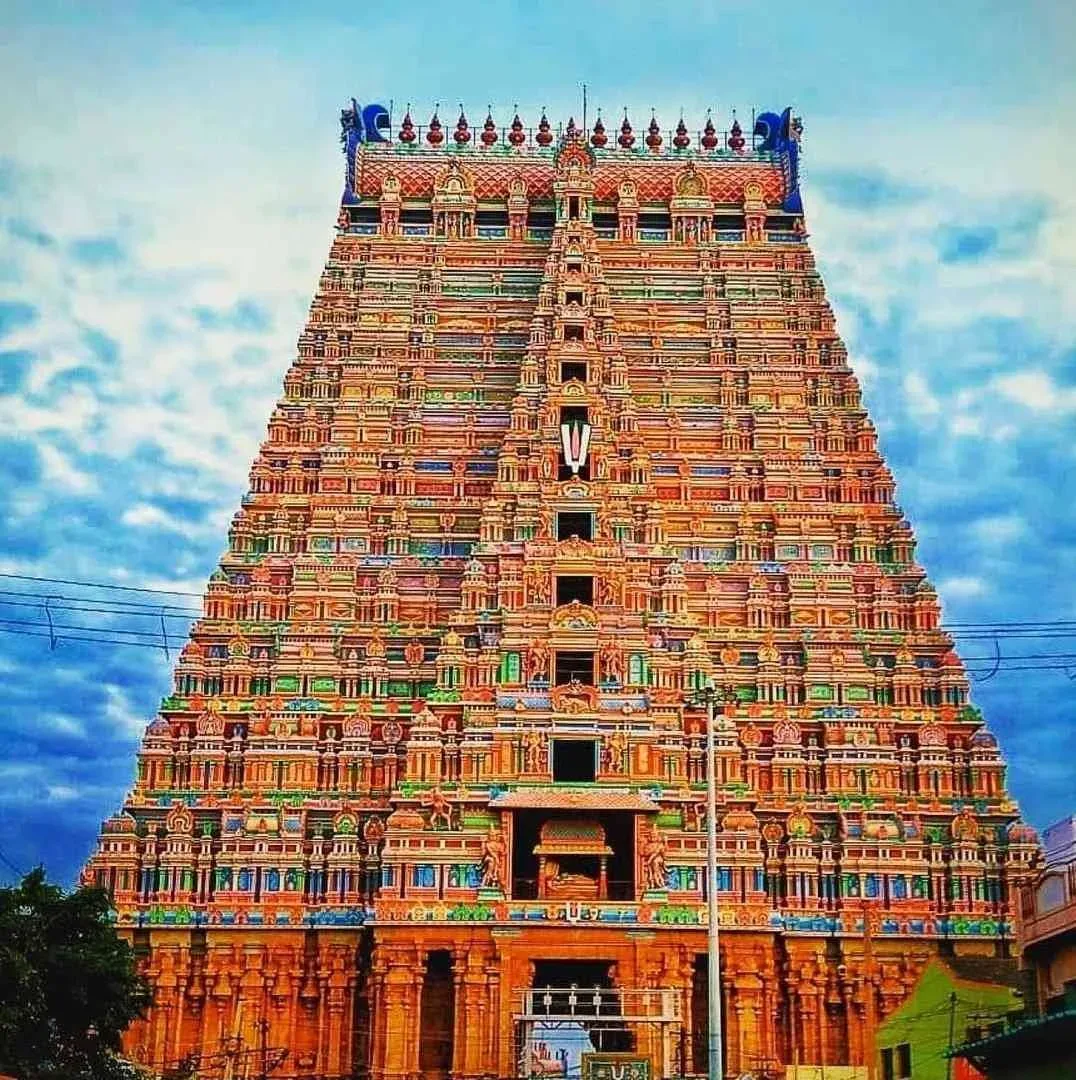
What makes it extraordinary is what fills those enclosures. The outer rings are not temple at all — they are streets. Houses, shops, tea stalls, flower sellers, people going to work. You pass through gateway after gateway and the city gradually thins out and becomes sacred, until somewhere around the fourth or fifth wall it stops being a town and starts being a temple. Nowhere else gives you that experience of walking inward through concentric degrees of holiness. It is a completely different kind of overwhelming from Varanasi's.
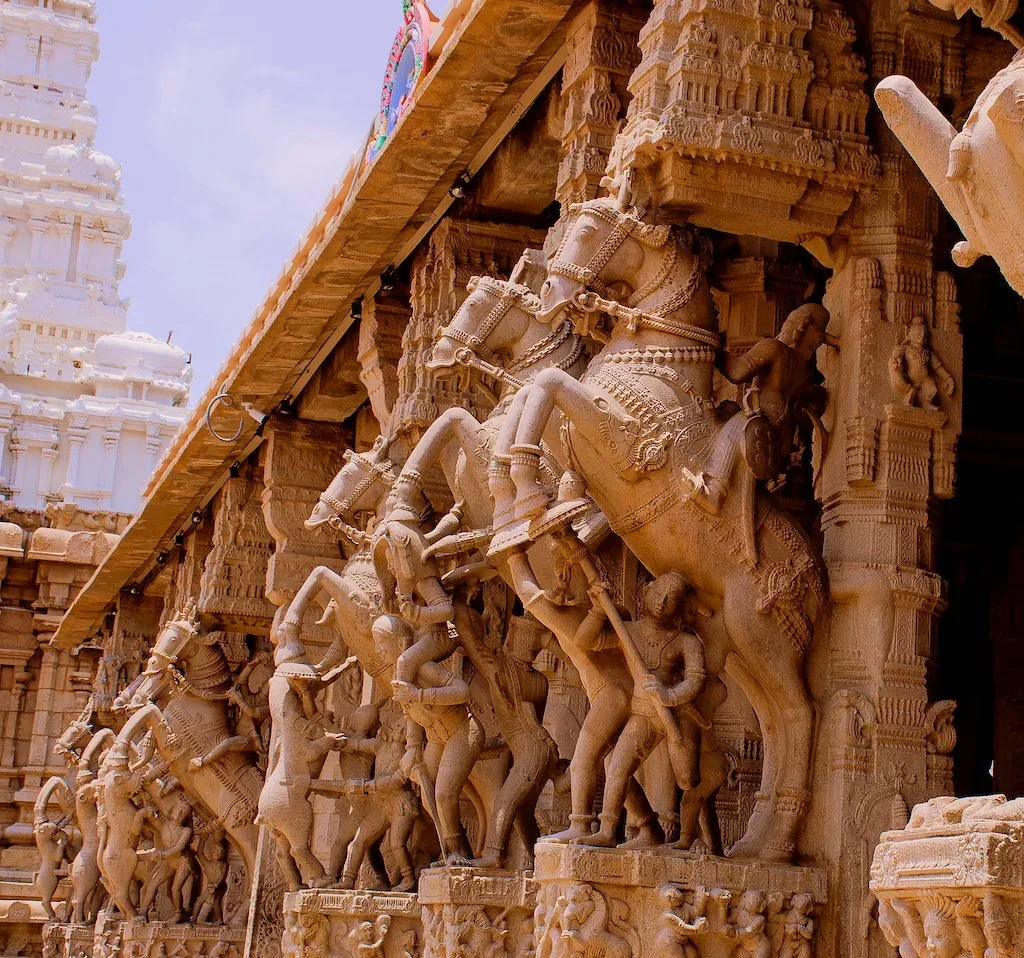
Lord Ranganatha reclines here on the serpent Adishesha, and this is the first and most important of the 108 Divya Desams — the shrines sung by the Alvar poet-saints. If that tradition interests you, it continues in our pilgrimage through the Nava Tirupathi.
Two practical things. The temple closes in three windows through the day — roughly mid-morning, midday and early evening — and visitors who don't check these lose hours. And non-Hindus are not admitted to the innermost sanctum, though the other six enclosures are open and are most of what you came for.
Across the river at Thiruvanaikaval is Jambukeswarar, the Water shrine of the five element temples, twenty minutes away and easily combined.
Srirangam sits alongside Thanjavur and Rameshwaram on our ten-day South India Temple Circuit — Tamil Nadu Pilgrimage, and appears on the Vaishnava route of In the Footsteps of the Golden Avatar, which retraces Chaitanya Mahaprabhu's South Indian yatra.
7. Madurai, Tamil Nadu — sensory overload, in the best possible way
If you visit one town on this list, visit this one.
Madurai is among the oldest continuously inhabited cities on earth, and it was built the way Varanasi was built — outward from a sacred centre, in concentric rectangular streets radiating from the Meenakshi Amman Temple. The temple has fourteen gopurams, and every square inch of them is covered in painted stucco figures: gods, demons, animals, celestial beings, thousands of them, stacked in rows, repainted in colours that have no business being that bright. The western tower is around 62 metres, second in India only to Srirangam's.
Inside, the Hall of a Thousand Pillars (985, in fact) has no two pillars alike. The Potramarai Kulam, the golden lotus tank, is where the city sits and talks. Corridors run further than you expect in every direction, and the whole thing is loud — bells, bare feet on stone, marigolds, camphor, the constant motion of a temple that thousands of people actually use every day.
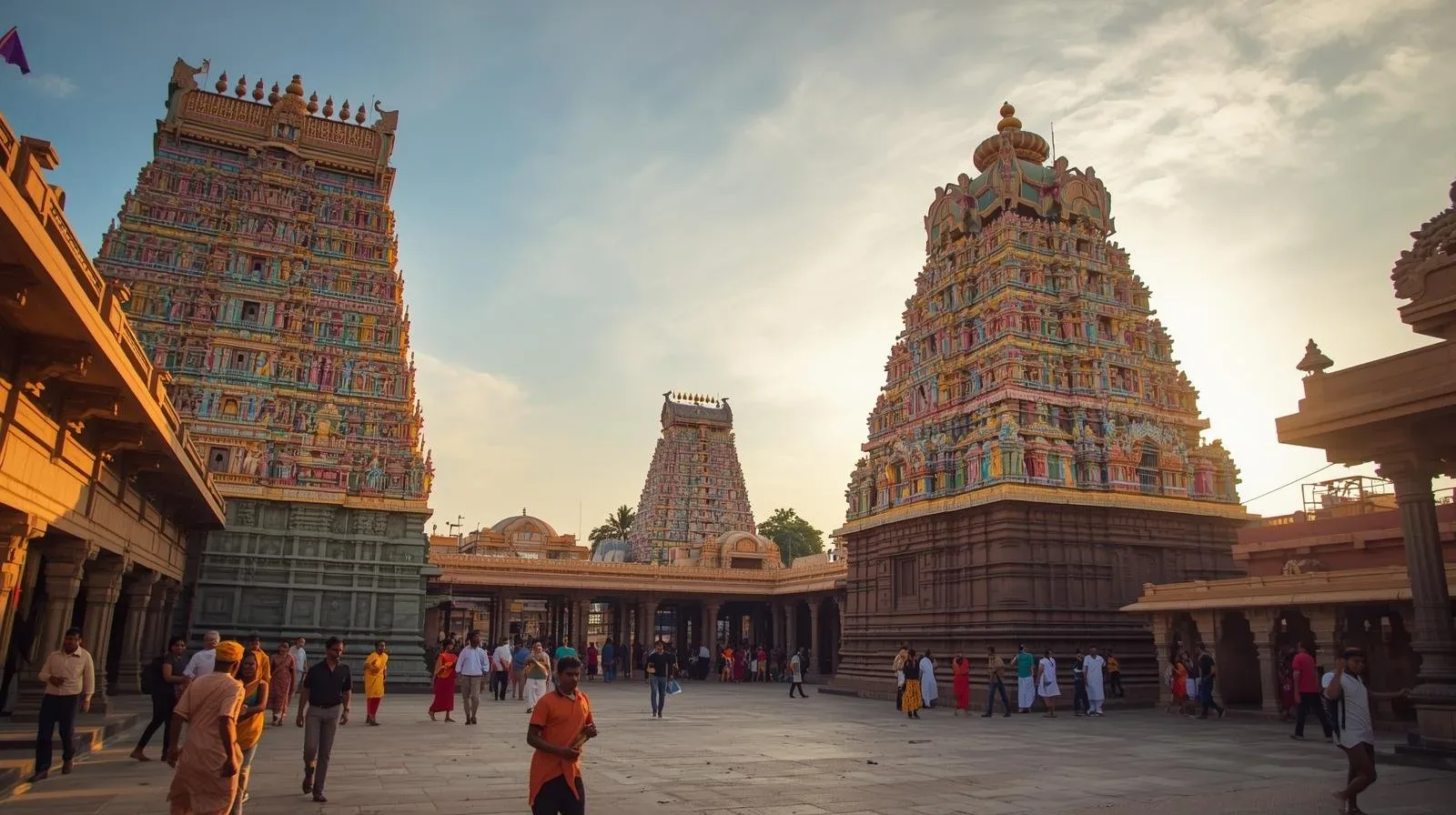
The thing to plan your day around is the 9 p.m. Palliarai ceremony. Sundareswarar is carried in procession to Meenakshi's chamber to spend the night, accompanied by drums and nadaswaram, and it is the single experience international visitors mention most often when they describe this temple. It runs nightly. Be there early.
Know before you go — Madurai has the strictest rules on this list:
- [object Object]
- [object Object]
- [object Object]
- [object Object]
Meenakshi is a form of the goddess in her own right, not a consort — the temple is named for her and she takes precedence over Shiva in it, which is unusual and worth understanding before you walk in. More on that tradition in our guide to the Devi temples of India. And if you're wondering about the temple elephant blessing visitors near the entrance, we explain why almost every Hindu temple has one.
8. Rameshwaram, Tamil Nadu — the quiet one at the end of the line
Rameshwaram sits on Pamban Island, at the very tip of the peninsula, connected to the mainland by a rail and road crossing over open sea — one of the more spectacular arrivals in India. It is one of the twelve Jyotirlingas and one of the four Char Dham sites, and mythologically it is where Rama worshipped Shiva after the war in Lanka.
Ramanathaswamy Temple has the longest temple corridor in India: the third prakaram runs well over a kilometre, a straight perspective of carved granite pillars receding until they blur. Photographs of it are everywhere; standing in it is better.
The ritual here is unusual and catches people out. There are twenty-two theerthams — wells — inside the complex, and pilgrims move from one to the next having buckets of water tipped over their heads before darshan. It is joyful and slightly chaotic and you will be soaked. Bring a change of clothes, keep electronics elsewhere, and either commit to it or stay dry deliberately.
Outside town is Dhanushkodi, a settlement destroyed by a cyclone in 1964 and left as it fell — church walls, a station, sand, and the point where the Bay of Bengal meets the Indian Ocean in a visible line. It is one of the emptiest, strangest places in South India.
This is the least crowded stop on the list, and the only coastal one. After the density of Madurai it functions as a decompression chamber.
If you're continuing rather than flying out, the road south leads to the tip of the subcontinent — see our complete Kanyakumari guide.
The festival calendar: what's on, and when
Catching one of these transforms a visit. It also multiplies the crowds, so decide deliberately.
TownFestivalWhenWhat happensMaduraiChithirai FestivalMid-April to early MayThe celestial wedding of Meenakshi and Sundareswarar. The biggest temple festival in Tamil Nadu; millions attend.MaduraiFloat Festival (Theppam)JanuaryDeities floated on the Mariamman Teppakulam tank at night. Beautiful, and far calmer than Chithirai.TiruvannamalaiKarthigai DeepamMid-to-late NovemberA beacon of roughly 3,500 kg of ghee lit on the summit of Arunachala, visible for tens of kilometres. Lakhs of pilgrims walk the Girivalam.SrirangamVaikunta EkadasiLate December (20 December in 2026)The Paramapada Vasal — the "Gateway to Heaven" — is opened. The 21-day Adhyayana Utsavam builds up to it.HampiHampi Utsav (Vijaya Utsava)Three days in February (13–15 February in 2026)The whole heritage site floodlit, folk processions, classical performances against the Stone Chariot and Virupaksha.RameshwaramMaha Shivratri; Thai AmavasaiFeb–March; JanuaryTen days of celebration at Ramanathaswamy; mass ritual bathing at Agni Theertham.KanchipuramPanguni Uthiram; Kamakshi BrahmotsavamFebruary–MarchChariot processions through the temple streets.Belur & HalebiduChennakeshava RathotsavaMarch–AprilA small, local car festival — no crowds, which is rather the point.
Two things to check before you book. Tamil festival dates follow the lunar and solar calendars and shift every year, sometimes by a day or two between localities — always confirm with the temple. And for Chithirai, Karthigai Deepam and Vaikunta Ekadasi, accommodation books out three to six months ahead. These are not last-minute trips.
One tip that saves an entire day at Srirangam: on Vaikunta Ekadasi itself, waits to pass through the Paramapada Vasal can exceed twelve hours. Visit during the surrounding Margazhi festival days instead and you get the same extraordinary atmosphere with a fraction of the queue.
When to go, town by town
These eight towns do not share a season, which is the single most common planning mistake.
Tamil Nadu plains — Madurai, Thanjavur, Srirangam, Kanchipuram, Tiruvannamalai
Go December to February. Comfortable temperatures, and it coincides with Vaikunta Ekadasi and Karthigai Deepam. Avoid April to June, when the plains sit at 38–42°C and the temple courtyards are unshaded granite — by midday the stone is genuinely too hot to cross barefoot, which is not optional. Note also that Tamil Nadu is watered by the northeast monsoon in October–December, not the southwest one; travellers who assume "monsoon means June" get this backwards.
Rameshwaram and Dhanushkodi
Go January to March. Humid year-round. Be cautious in October–December, when cyclone risk on the Coromandel coast can close access to Dhanushkodi and disrupt the Pamban crossing.
Hampi
Go November to February. Avoid March to May — the boulder field radiates heat and there is no shade on Matanga Hill. During the southwest monsoon, June to September, the Tungabhadra runs high and coracle crossings can suspend.
Belur and Halebidu
Go October to February. This is the greenest stretch of the route, and the soapstone reads best in soft light.
The trade-off nobody tells you: the two greatest festivals sit at opposite ends of the comfort scale. Karthigai Deepam falls in November, in good weather, at peak crowding. Chithirai is the most spectacular event in the Tamil calendar and falls in the worst month of the year for heat. There is no version of this where you get both.
What international visitors should expect
Consolidated, so you can read it once and stop worrying.
Inner sanctums. At several major temples — Meenakshi and Srirangam among them — non-Hindus are not admitted to the innermost shrine. In practice this is a small fraction of the complex. Visitors almost universally report having far more access than they were denied. Signage marks the stopping point clearly; nobody will embarrass you.
Cameras and phones. Rules vary sharply. Meenakshi bans phones and cameras outright. Others allow phones in the outer courtyards but not near the sanctum. Assume restricted, carry as little as possible, and use the lockers.
Footwear. Off at every entrance, without exception, including outer courtyards. Free or near-free stands are available at all gates. Socks are usually tolerated; on hot afternoons they are a genuine mercy.
Tickets. Most temples are free to enter. A few charge foreign visitors a nominal ticket (around ₹50), and paid express-darshan queues exist at the busiest shrines.
Closure windows. Almost every temple on this list shuts for several hours in the middle of the day. Check timings for the specific day you're going, not a generic listing.
For how to actually move through a South Indian temple — the order of shrines, what to do at Nandi, how many circuits to walk — see our beginner's guide to visiting Shiva temples in South India and 20 tips for foreigners visiting Indian temples. If you want to understand why these buildings are shaped the way they are — the geometry, the orientation, the logic of the enclosures — start with the spiritual significance of South Indian temples.
How the eight connect
Don't try to cover South India in one trip. There are two natural circuits, and they join in the middle.
The Karnataka leg (4–5 days). Fly into Bengaluru. Drive to Hassan for Belur and Halebidu, then north to Hampi via Hospet. Hampi's nearest airport is Jindal Vijaynagar, about 40 km away; the nearest railhead is Hospet Junction, about 13 km. From Hampi you can fly or take an overnight train south.
The Tamil Nadu leg (6–7 days). Enter at Trichy for Srirangam, then Thanjavur, then Madurai, then Rameshwaram, and fly out of Madurai. This is the tightest, most rewarding stretch on the list, and it works as a standalone trip.
Adding Kanchipuram and Tiruvannamalai. These sit on the Chennai side and belong to a different arc: Chennai → Kanchipuram → Tiruvannamalai → Thanjavur, which then joins the Tamil Nadu leg. If you're flying into Chennai rather than Bengaluru, start here.
A realistic full circuit is fifteen days, not ten: Bengaluru → Belur/Halebidu → Hampi → Trichy/Srirangam → Thanjavur → Madurai → Rameshwaram → out of Madurai. On paper you can compress this to ten. In practice ten days means you spend the trip in transit, arrive at each temple in the wrong half of the day, and miss the closure windows repeatedly. Fifteen gives you two nights in most towns, which is the difference between photographing a place and understanding it. It also leaves room for the thing every itinerary underestimates, which is how long the ordinary business of eating and moving actually takes here.
A realistic short version, if you're already in the deep south, is four days: Madurai → Rameshwaram → Srirangam → Thanjavur.
Trains between Tamil Nadu's temple cities are frequent, cheap and genuinely pleasant; Karnataka's distances are better covered by car. We've set out the options in our India transportation guide for international travellers.
The part nobody plans for
Everything above is the good news. Here is the honest part.
The temples are not the hard bit. The hard bit is the space between them.
Transport. Individually, every leg is solvable. Cumulatively, it eats your trip. Trains sell out weeks ahead in season and the booking system is not built for foreign cards. Buses run beautifully if you can read the destination boards, which are frequently in Tamil script only. Drivers are easy to find and vary enormously — some are superb, some will quietly reroute you through a cousin's silk shop in Kanchipuram. None of this is dangerous. All of it is tiring, and it compounds across fifteen days.
Accommodation. Temple towns are pilgrim towns, and pilgrim towns book by lunar calendar, not by tourist season. A room that costs very little in March costs several times that during Chithirai, and around Karthigai Deepam in Tiruvannamalai the whole town is simply full three months out. Some of the best places to stay in Rameshwaram and Hampi have no meaningful online presence at all. The listings you can find from abroad are not the listings that locals use.
And then there is food — which is the thing that actually breaks people.
This is the single most underestimated difficulty on a South Indian temple circuit. The food here is extraordinary — genuinely some of the best vegetarian cooking on earth — and it is also unfamiliar in ways that catch travellers off guard. Meals run on a local clock: a proper banana-leaf lunch is served in a narrow window around midday and then simply stops. Many of the best places are single-room establishments with no menu, no English and no sign, where you sit down and food arrives. Breakfast is idli and dosa and nothing else, which is wonderful for four days and harder on day eleven. Portions of chilli are calibrated for people who grew up with them. And in a small temple town at nine in the evening, after a long darshan, the honest options can narrow to a packet of biscuits.
Travellers who eat well in South India almost always have one thing in common: somebody told them where to go. Not a review site — a person. Which stall does the good filter coffee, which mess is safe, where you can get a plain curd rice at ten at night when your stomach has had enough, how to ask for less heat without giving offence, what the prasad you were just handed actually is and whether you should eat it. That knowledge does not exist in a searchable form. It's transmitted. (Our guide to eating in South India will get you a long way — but it can't sit beside you at the table.)
Which brings us to the real gap.
A driver will get you to all eight towns. He'll wait outside while you go in, and he'll get you to the next place safely. What he cannot do is tell you why the bell is rung before you cross the threshold, or why this particular city is laid out in concentric rectangles, or what is happening in the ritual you are watching at nine at night in Madurai, or what the priest just said to you. You can stand in the most extraordinary temple in Asia and receive almost nothing from it, because nobody translated it.
That is a real loss, and it's the loss most independent travellers on this route actually suffer. Not danger. Not discomfort. Just standing in front of something profound with no way in.
Or let someone hold it for you
This is precisely the problem Smukti was built around, and the reason we don't send people out with guides.
A Smukti Dhost — from dost, friend, and host — is not a guide and not hotel staff. They're verified locals who are spiritually rooted as well as culturally fluent: Sanskrit scholars, classical dancers, historians, yoga teachers, temple families. They do three things a driver cannot. They decode — the why behind the ritual, not the date on the plaque. They buffer — the haggling, the crowds, the queues, the closure windows, the room that was supposed to be booked. And they accompany — they sit with you over chai at the roadside stall where the good coffee is, and tell you about their own tradition as a peer rather than an employee.
They also, very practically, know where to eat.
If you would rather arrive and simply be present, these towns sit across a few of our journeys:
- [object Object]
- [object Object]
- [object Object]
- [object Object]
Booked or independent, go. Just go knowing which parts of it are actually difficult.
Frequently asked questions
Can non-Hindus visit these temples?
Yes — all eight towns are open to everyone. At a few of the largest temples, including Meenakshi Amman in Madurai and Sri Ranganathaswamy in Srirangam, the innermost sanctum is restricted to Hindus. The rest of the complex, which is the overwhelming majority of what makes these places extraordinary, is open to all visitors.
Which of the eight is least crowded?
Belur and Halebidu, comfortably — they see a fraction of the visitors the Tamil temple cities do. Rameshwaram is the quietest of the Tamil Nadu stops outside festival periods. Madurai and Srirangam are the busiest year-round.
What is the best month to visit South Indian temple towns?
January is the strongest single month across all eight: dry, comfortable in both states, and it catches Madurai's Float Festival. December and February are close behind.
How many days do I need?
Fifteen days covers all eight properly, with two nights in most towns. Ten is possible but you'll spend it in transit and keep arriving during temple closure windows. Four days covers the Tamil Nadu core — Madurai, Rameshwaram, Srirangam, Thanjavur. Anything under three days means one town, done well, which is a better trip than three towns done badly.
What's the hardest part of doing this independently?
Not safety and not the temples — it's food and the gaps between towns. Meal times run on a local clock, the best places have no signage or English, and by late evening in a small temple town the options thin out fast. Transport and rooms are individually solvable but cumulatively exhausting over two weeks.
Do I need a guide?
For Hampi and the Hoysala temples, yes — the carving detail is largely invisible without one, and ASI-licensed guides at Belur and Halebidu are excellent. For the Tamil temple cities, the issue isn't navigation but meaning: a driver gets you there, but can't tell you what you're looking at. That's the gap a Smukti Dhost is built to fill.
Is this a good first trip to India?
Better than Varanasi, for most people. Tamil Nadu is easier to move around, the food is gentler on new arrivals, and the temple cities give you scale and beauty before they ask anything difficult of you. For a wider view of what draws people south, read why South India calls to Western seekers of bhakti.
Festival dates and temple timings change. Verify with the temple before you book. Last verified: July 2026.