About this article
Planning a trip to India? Your packing strategy can make or break your experience. After spending months traveling across this vast country, I learned that packing for India isn't about stuffing your suitcase full—it's about bringing the right essentials while leaving room for flexibility. Here's everything you need to know about what to pack (and what to leave at home) for your Indian adventure.
Understanding India's Climate Zones: It's Not One-Size-Fits-All
The biggest packing mistake travelers make? Treating India like a single climate zone. This country spans everything from snow-capped Himalayan peaks to steamy tropical beaches, and your packing list needs to reflect where you're going and when.
North India (October-March): Winter Is Real
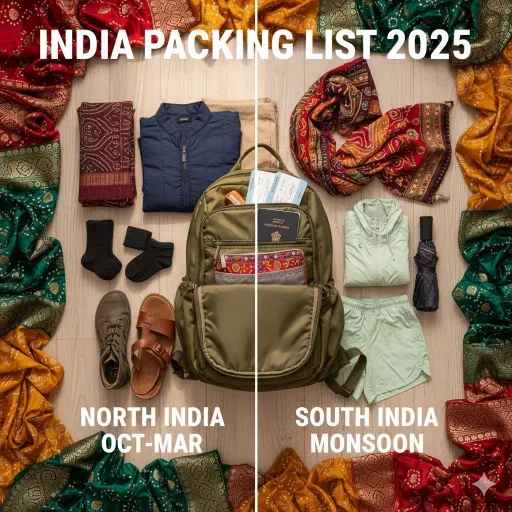
If you're visiting Delhi, Agra, Jaipur, or Varanasi between October and March, pack like you're heading somewhere genuinely cold. December and January temperatures regularly drop to 5-10°C (40-50°F), with Delhi experiencing foggy mornings that feel bone-chilling when you're used to thinking of India as perpetually hot.
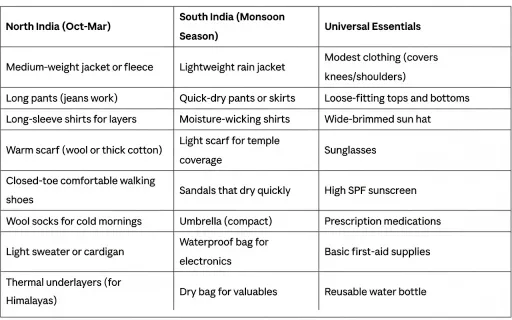
What you actually need: A proper jacket or fleece, long pants, a warm scarf (which doubles as temple coverage), and closed-toe shoes. Layering is your best friend—mornings are cold, afternoons warm up, and evenings get chilly again. If you're heading to Ladakh or the Himalayas, bring full winter gear. Snow is possible even in September at high altitudes.
South India: Hot, Humid, and Monsoon-Ready
Kerala, Chennai, Goa, and most of South India maintain warm to hot temperatures year-round. Your packing focus here shifts to breathable, moisture-wicking fabrics that can handle humidity and sudden downpours.
During monsoon season (June-September), rain isn't a gentle drizzle—it's torrential. Pack a lightweight rain jacket, quick-dry clothing, and sandals that can get wet. Cotton sounds appealing but takes forever to dry. Synthetic blends or moisture-wicking materials work better in tropical humidity.
The 40-Degree Reality
April through June brings scorching heat across most of India, with temperatures regularly hitting 40°C (104°F) or higher. If you're traveling during Indian summer, pack the lightest, loosest, most breathable clothing you own. This is not the time for tight jeans or synthetic fabrics.
The Smart Layering Strategy
Instead of packing separate wardrobes for different regions, focus on versatile pieces that layer well. A lightweight long-sleeve shirt works as sun protection in hot weather and as a base layer in cold weather. Scarves serve as warmth, temple coverage, and impromptu blankets on cold train rides. This approach saves luggage space and adapts to India's microclimates.
The Modest Dress Code: What It Actually Means
Let's cut through the confusion about modest dress in India. Here's what you actually need to know, beyond the vague advice to "dress conservatively."
The Basic Coverage Rule
Modest dress means covering three key areas: knees, shoulders, and chest. This applies everywhere from temples to city streets, though enforcement and expectations vary by location.
For women, this typically means pants or skirts that fall below the knee, tops that cover your shoulders, and necklines that don't show cleavage. For men, shorts above the knee can draw attention or prevent temple entry, and tank tops are generally inappropriate outside beach areas.
Loose vs. Tight Matters
Coverage alone isn't enough—fit matters too. Loose, flowing clothing reads as more modest than tight, form-fitting clothes even if they cover the same amount of skin. This is why you'll see experienced travelers wearing loose linen pants and oversized kurtas rather than skinny jeans and fitted tees.
The Layering Strategy for Photos
Want to wear that cute crop top or tank top you packed? The solution is simple: bring a big, lightweight button-up shirt or shawl to throw over it. Wear your preferred outfit underneath, cover up when walking through streets or visiting sites, then remove the layer for photos in appropriate settings. This gives you outfit flexibility without constantly attracting unwanted attention.
Temple and Religious Site Requirements
Religious sites often have stricter rules. Many temples require covered shoulders and knees at minimum, while some require covered legs entirely (meaning pants or long skirts, not below-knee shorts). Sikh temples require head coverage. Some temples don't allow leather items inside. Check specific requirements before visiting major religious sites.
Regional Variations
Goa beaches operate on completely different norms than Delhi streets. You'll see bikinis and beachwear in coastal resort areas that would be inappropriate in northern cities. Use common sense: match your clothing to your surroundings and the comfort level of locals around you.
Pharmacy Items: What to Bring vs. What to Buy There
One of the biggest surprises about India? The pharmacy situation is actually excellent.
Bring From Home
Prescription medications: Bring enough for your entire trip plus extras. While many prescriptions are available in India, getting them without local prescriptions can be complicated. Bring medications in original packaging with prescriptions if possible.
Specific feminine products: While pads and tampons are available in cities, your preferred brands might not be. Menstrual cups are hard to find. If you have specific preferences, bring them from home.
Specific allergy medications: Your exact preferred antihistamine might not be available, so bring what works for you.
Birth control: If you're on a specific brand or type, bring your supply.
Easily Available in India
Indian pharmacies are well-stocked, affordable, and surprisingly accessible. Many medications that require prescriptions in Western countries are available over the counter in India.
Antibiotics: Available without prescription at most pharmacies. Helpful if you develop an infection during your trip.
Pain relief: Paracetamol (acetaminophen) and ibuprofen are cheap and widely available.
Stomach medications: Probiotics, anti-diarrheal medication, and antacids are everywhere. You'll probably need them at some point.
Creams and ointments: Antiseptic creams, anti-fungal treatments, and moisturizers are readily available.
Basic first-aid supplies: Bandages, gauze, and antiseptic wipes can be purchased anywhere.
Medical Care Quality
Don't let stereotypes fool you—India has excellent hospitals and medical care, especially in major cities. Private hospitals in Delhi, Mumbai, and Bangalore rival facilities anywhere in the world, and care is far more affordable than in the US. If you need medical attention during your trip, you have good options.
Power Adapters and Electronics: The Essential Setup
The Plug Situation
India uses Type C, D, and M plugs—the same two-round-prong or three-round-prong system used in South Africa and parts of Europe. If you're coming from North America or the UK, you need an adapter. Buy a universal adapter that works in India rather than country-specific ones, giving you flexibility for future travel.
Voltage Considerations
India runs on 230V/50Hz electricity. Most modern electronics (phones, laptops, cameras) have dual-voltage chargers that work fine, but check your devices. Hair dryers and other high-wattage items might need voltage converters or might not work at all.
Train Charging Reality
Indian trains have charging points in most AC classes, but they're often limited and sometimes non-functional. Bring a power bank for your devices. Long-distance train journeys can last 24+ hours, and you'll want your phone charged for photos, entertainment, and navigation.
Airport Security Warning
Indian airport security is thorough. At security checks, you need to completely unpack all electronics—laptops, tablets, cameras, chargers, power banks—and place them in separate trays. Don't bury electronics deep in your bag. Keep them accessible to avoid repacking your entire backpack at security.
India's Luxury Shopping Scene: You Can Find More Than You Think
Forget the idea that you need to pack everything because India is a developing country. Major Indian cities have impressive shopping infrastructure.
International brands: Sephora, H&M, Zara, Birkenstock, Decathlon, and numerous other international brands have stores in Delhi, Mumbai, and Bangalore. Forgot your favorite moisturizer? You can probably find it.
Quality malls: Modern shopping malls in major cities rival anything in the West, with air conditioning, food courts, and every amenity you'd expect.
Local alternatives: Indian brands offer excellent quality at lower prices. Fabindia makes beautiful cotton clothing perfect for Indian weather. Forest Essentials creates luxury skincare products using traditional ingredients.
Custom tailoring in Jaipur: One of India's unique advantages is quick, affordable custom tailoring. Jaipur is famous for this, but most cities have talented tailors who can create custom-fitted clothing in 24-48 hours for reasonable prices.
The bottom line: Don't stress about forgetting basics. You can replace or purchase most items in India, often for less than you'd pay at home.
Luggage Type: Why Backpacks Beat Rolling Suitcases
This recommendation matters more than you might think. India's infrastructure isn't designed for wheeled luggage.
Train Platform Realities
Indian train platforms are accessed by stairs, not escalators. Platforms can be long—sometimes 500 meters or more—and you'll be dragging luggage through crowds. A backpack lets you move freely with both hands available. A rolling suitcase becomes an awkward, heavy burden you're constantly lifting over obstacles.
Street Conditions
Indian streets rarely have smooth sidewalks. You'll encounter broken pavement, dirt roads, potholes, and crowded markets where wheeled luggage is more obstacle than convenience. A backpack distributes weight across your shoulders and leaves you mobile.
Transportation Space Constraints
Tuk-tuks (auto-rickshaws) have limited luggage space. Buses pack bags on roof racks. Train luggage storage varies by class. A compact backpack fits everywhere. An oversized rolling suitcase becomes a negotiation at every transition.
Mobility Through Crowds
India is crowded. Streets, train stations, markets, and tourist sites teem with people. A backpack lets you navigate through crowds efficiently. Wheeled luggage creates a barrier that slows you down and annoys everyone around you.
Recommended approach: A 40-50L travel backpack as your main bag, plus a small daypack (20-25L) for daily exploration. This setup gives you flexibility, mobility, and enough space for everything you actually need.
The Non-Negotiable Essentials: Items You'll Use Every Day
These aren't glamorous, but they're the items you'll reach for constantly and be grateful you packed.
Tissues and Toilet Paper
Many Indian bathrooms don't provide toilet paper, particularly squat toilets in public places, train stations, and rural areas. Carry tissues or a small roll of toilet paper with you at all times. You'll also use tissues for wiping hands, cleaning surfaces, and dealing with perpetual dust.
Hand Sanitizer
You'll use this constantly. After tuk-tuk rides where you held onto dusty bars, before eating street food, after handling money, after temple visits where you removed shoes and walked barefoot. Keep a small bottle accessible in your daypack and refill it from a larger bottle in your main luggage.
Wet Wipes
Sometimes there's no running water. Sometimes the water is questionable. Wet wipes solve both problems. Use them to clean hands, freshen up during long train journeys, wipe down airplane trays, and clean surfaces before sitting. Pack more than you think you need.
Reusable Water Bottle
Staying hydrated in India's heat is crucial, but buying plastic bottles constantly is expensive, environmentally damaging, and generates mountains of waste. A reusable bottle with a built-in filter lets you refill from taps in many places (hotels, restaurants) or from purified water stations. LifeStraw and Grayl make excellent filtered bottles.
Small Daypack for Daily Exploration
Your large backpack stays at your accommodation. Your daypack carries everything you need for a day out: water bottle, sunscreen, camera, tissues, hand sanitizer, rain jacket, snacks, guidebook, and any purchases. Choose something light, with anti-theft features if possible, and comfortable enough to wear for hours.
Additional Essentials Worth Mentioning
Headlamp or small flashlight: Power outages happen, and not all accommodations have reliable lighting. A headlamp leaves your hands free.
Padlock: For hostel lockers and some budget hotel rooms. Combination locks are easier than remembering where you put tiny keys.
Ziplock bags: Keep electronics, documents, and valuables dry during monsoon season or dusty during desert regions.
Sarong or large scarf: Serves as beach blanket, modest temple covering, airplane blanket, curtain for hostel bunks, and impromptu towel.
Wallet setup: Pack your Wise or Revolut card for hotel and restaurant payments. Download the Mony app before you leave and load it with funds — it's the closest thing foreigners have to India's UPI scan-and-pay system. Always carry rupees in small denominations for street food, auto-rickshaws, and temple donations. Full guide: How to pay in India as a foreigner.
What NOT to Pack: Leave These at Home
Just as important as what to bring is what to leave behind.
Expensive jewelry: India is generally safe, but why risk losing valuable items? Leave expensive jewelry at home and buy beautiful costume jewelry in India instead.
Your entire shoe collection: You need three pairs maximum: walking shoes, sandals, and perhaps flip-flops for hostel showers. India's dusty conditions will destroy shoes anyway.
Too many clothes: You can wash clothes easily and cheaply anywhere in India. Pack a week's worth of clothing maximum and plan to do laundry.
Hair dryers and styling tools: Unless you know your accommodation has appropriate voltage, leave them home or buy local versions. Your hair won't look perfect in India's humidity anyway—embrace it.
Full-size toiletries: Buy travel sizes or refill containers. You can purchase more in India if needed. Your luggage weight is better spent on other essentials.
Books: Bring a Kindle instead of heavy paperback books. You can also participate in India's thriving book exchange culture at hostels and cafes.
Final Thoughts: Pack Light, Travel Smart
The best packing advice for India? Bring less than you think you need. You'll realize within days that you're wearing the same comfortable, modest, weather-appropriate outfits on rotation and leaving the rest in your bag.
India offers incredible shopping opportunities, so leave space in your luggage for purchases. The textiles, jewelry, spices, and handicrafts you'll want to bring home deserve more room than excess clothing you never wore.
Focus your packing on versatile, quality essentials that serve multiple purposes. A good backpack, modest breathable clothing appropriate for your destination's climate, essential medications and hygiene items, and the non-negotiables listed above will serve you far better than an overstuffed suitcase.
Most importantly, remember that India has everything you might need. Forgot something? You can buy it there, probably for less money. Packed the wrong thing? Adapt and adjust. The best travelers are flexible ones who focus on experiences rather than perfect packing lists.
Now stop overthinking your packing list and start getting excited about your Indian adventure. The country's chaos, beauty, and overwhelming sensory experience await—and no packing list can fully prepare you for that.