About this article
Walk into a Sivananda class anywhere in the world — Rishikesh, Kerala, New York, São Paulo — and you will find the same twelve postures, in the same order, framed by the same opening relaxation, the same two breathing practices, and the same closing rest. This is not repetition for its own sake. It is the point.
The genius of the Sivananda method isn't found in any single posture. It's found in the intelligence of the sequence itself — a structure designed by Swami Sivananda Saraswati to move a practitioner, in one class, through the body, the breath, the prāṇa, and the mind. Every section prepares the next. Nothing is arbitrary.
This piece walks through that architecture stage by stage. At the end, we'll take you somewhere the sequence itself can't: to Pattamadai, the small town in Tirunelveli district where the man who designed it was born.
The sequence begins with stillness
Before a single posture, before even the breath work, the class begins with initial relaxation. The body settles. External distractions quiet. The mind becomes present.
This isn't a warm-up in the conventional sense — it's a deliberate reset. A body that arrives from traffic, from a workday, from an argument, cannot benefit fully from what follows until it has been given a few minutes to simply arrive. Sivananda's method treats this as non-negotiable: you cannot build an intelligent sequence on top of a distracted starting point.
Prāṇāyāma: the breath prepares the mind
With the body settled, the class moves into two specific breathing practices — Kapalabhati and Anuloma Viloma.
Kapalabhati ("skull-shining breath") is used to cleanse, activate, and energise. Its short, forceful exhalations clear stale air from the lungs and stimulate the nervous system, waking the practitioner up from the inside.
Anuloma Viloma (alternate nostril breathing) balances the nervous system, steadies the mind, and improves concentration, working the two nostrils — and by extension the two hemispheres — into equilibrium.
Together, they set the foundation for the āsana practice ahead. A calm, oxygenated, focused mind changes how the body experiences the postures that follow — this is why the breath comes before the movement, not after.
Sūrya Namaskāra prepares the body
Only now — mind steadied, breath regulated — does the body begin to move, through Sūrya Namaskāra (Sun Salutations). Its job is entirely preparatory:
- [object Object]
- [object Object]
- [object Object]
- [object Object]
- [object Object]
By the time Sūrya Namaskāra ends, the body and mind are ready for what the sequence is actually built around: the twelve basic āsanas.
The 12 basic āsanas
This is the spine of the Sivananda class — twelve postures, always in this order:
- [object Object]
- [object Object]
- [object Object]
- [object Object]
- [object Object]
- [object Object]
- [object Object]
- [object Object]
- [object Object]
- [object Object]
- [object Object]
- [object Object]
Most practitioners can name these postures. Far fewer can explain why they appear in this order — and that order is where the actual teaching lives.
The power lies in the order
The twelve āsanas follow a carefully orchestrated progression, category by category:
Inversions → Forward bends → Backbends → Twists → Balancing postures → Standing postures → Final relaxation
This isn't just a physical sequence. It's designed on two levels simultaneously.
Anatomical and physiological science
The sequence moves in a deliberate top-down progression through the body's own systems: nervous, endocrine, respiratory, cardiovascular, lymphatic, digestive, reproductive, and musculoskeletal. Each posture group is chosen and ordered to work through a specific system before handing off to the next.
Energetic intelligence
Read through the lens of prāṇa, the same order tells a different story:
- [object Object]
- [object Object]
- [object Object]
- [object Object]
- [object Object]
- [object Object]
- [object Object]
Swap the order — put backbends before inversions, or standing postures before twists — and the sequence stops making sense on both counts. The physical logic and the energetic logic are the same logic, seen from two angles. That's the "intelligence" the sequence is named for.
Effort and conscious rest
One of the defining characteristics of the Sivananda method is the alternation between effort and conscious rest. Between each posture, a brief śavāsana allows the body to rest, the breath to settle, and the effects of the posture to be absorbed before moving to the next.
This is easy to underestimate. It's tempting to think of the rest as a pause in the practice. In the Sivananda system, it is the practice — the moment where the posture's effect is actually integrated rather than simply performed.
The practice culminates with rest
After Trikoṇāsana, the sequence closes the way it opened: with rest. Tension-release exercises and a guided body-scan autosuggestion lead into final relaxation — the same śavāsana that appeared, briefly, between every posture, now given its full length.
One sequence. One complete practice.
Strung together, the stages do what no single posture could do alone:
- [object Object]
- [object Object]
- [object Object]
- [object Object]
- [object Object]
- [object Object]
The whole being — not one system in isolation — is the actual subject of the class. And this is a practice designed to be returned to every day, in the same order, for exactly that reason: the order is the method.
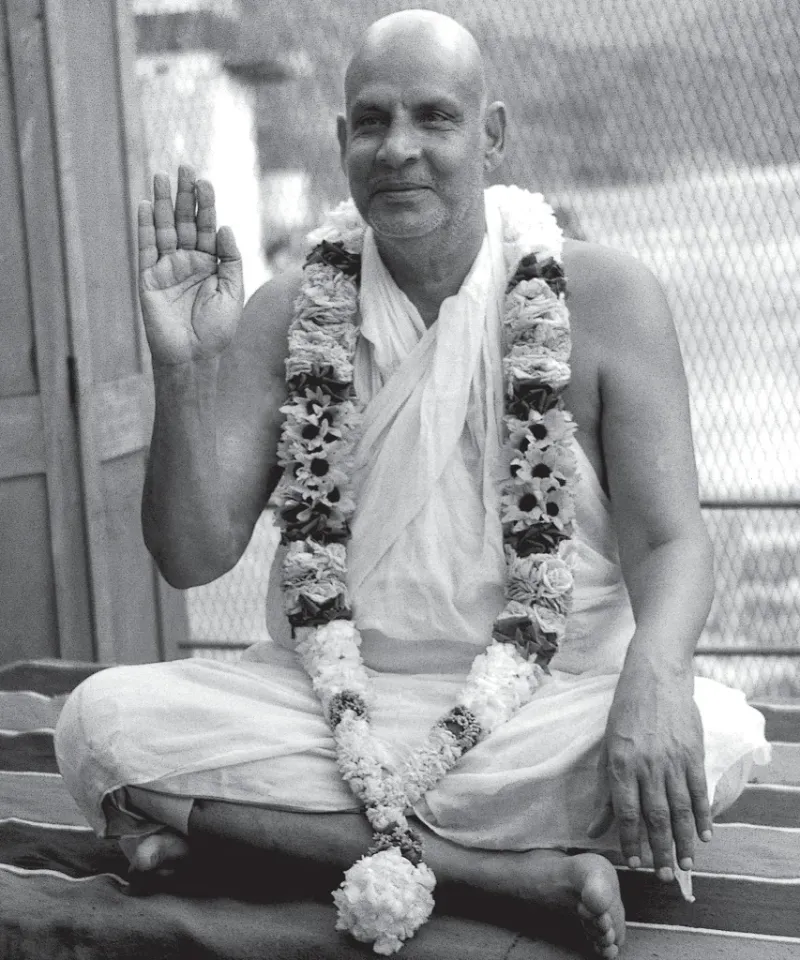
Where the sequence was designed: Pattamadai
Swami Sivananda Saraswati — the founder of the Divine Life Society, author of more than two hundred books on yoga and Vedanta, and the teacher whose direct students carried this exact sequence out of India and into yoga studios across the Western world — was born in Pattamadai, a quiet town in Tamil Nadu's Tirunelveli district, seventy kilometres north of Kanyakumari, on the banks of the Tamirabarani River.
It's a place most practitioners of Sivananda yoga never think to visit, in part because it sits well off the usual pilgrimage circuit — no major ashram, no famous temple complex, just the town itself and the river that runs through it. But for anyone who has stood at the top of their mat between two śavāsanas and felt that alternation of effort and rest do its quiet work, Pattamadai is where that idea originated.
Visit Pattamadai on Smukti's Living Masters of India — Southern Tip tour
Smukti's Living Masters of India: Southern Tip tour is a ten-day route from Trivandrum (Kochi start/end also available) through one of the most spiritually concentrated stretches of geography in India — the land between Kanyakumari and the Kerala backwaters.
Day 4 of the itinerary is built around Pattamadai itself:
- [object Object]
- [object Object]
- [object Object]
- [object Object]
The route continues on to Tenkasi's Thirumalai Murugan Temple, Amritapuri Ashram (with the possibility of darshan with Amma), Sivagiri Mutt at Varkala to learn about Sree Narayana Guru, and Kanyakumari, where Swami Vivekananda meditated before sailing to America to introduce Vedanta to the West. Along the same coastline, the ancient Siddha sage Agasthiyar is said to have meditated in the hills above Kanyakumari, and Mayamma, the woman saint of Kanyakumari, lived out a life of complete devotion and service.
Few places let you walk this directly from a teaching you already practice to the ground it came from. If the Sivananda sequence has shaped your own daily practice, Pattamadai is where that particular thread of the story begins.
View the Living Masters of India: Southern Tip tour →
Swami Sivananda was born in Pattamadai. Living Masters of India – Southern Tip visits his birthplace and other sacred sites across southern India on a 10-day / 9-night journey.