About this article
Namaste, dear friends.
It was a true joy to share space with so many of you during my recent session, Pranayama: Lost in Translation. Whether you joined live or are reading this for the first time, I’m deeply grateful you’re here. This conversation is one that’s been living in me for many years—one I felt increasingly compelled to share as I observed how the heart of Pranayama has often been misunderstood or, quite literally, lost in translation.
For the past four decades, I’ve walked the path of Yoga. I’ve taught for over 30 years, trained teachers for 20, and in recent years, I’ve been diving deeply into Sanskrit to go back to the roots of the tradition. What I found, again and again, was this: what many in the modern yoga world call “Pranayama” has very little to do with the original intent of this sacred practice.
So let’s begin there.
Prana Is Not Breath
This is perhaps the most essential point I want to share with you: Prana is not breath.
In Sanskrit, Prana means “life” or “life force.” Ayama means “expansion” or “extension.” Pranayama, therefore, means the expansion of life, not the control of breath.
When Yoga came to the West, Prana was unfortunately translated as “breath,” and Pranayama as “breath control.” But this is a profound mistranslation—one that shifts the entire practice onto a different track. You cannot control Prana with breath. You can only experience it, purify the pathways through which it moves, and allow it to expand.
Prana is the living essence within us—the force that animates life. It begins long before our first breath. In fact, I believe Prana enters around the seventh week of pregnancy, when the umbilical cord connects the fetus to the mother. This is echoed in both Buddhist traditions (where consciousness is said to arrive on day 49) and the insights of Rudolf Steiner.
The breath, then, is only a rhythm within which Prana can be perceived—not the source of Prana itself.
The Five Koshas: Layers of Being
To understand Prana, we must move beyond the physical. The Taittiriya Upanishad speaks of five Koshas, or layers of being:
- Annamaya Kosha – The physical body, sustained by food.
- Pranamaya Kosha – The energy body, sustained by Prana.
- Manomaya Kosha – The mental-emotional body.
- Vijnanamaya Kosha – The body of wisdom and discernment.
- Anandamaya Kosha – The innermost layer of bliss.
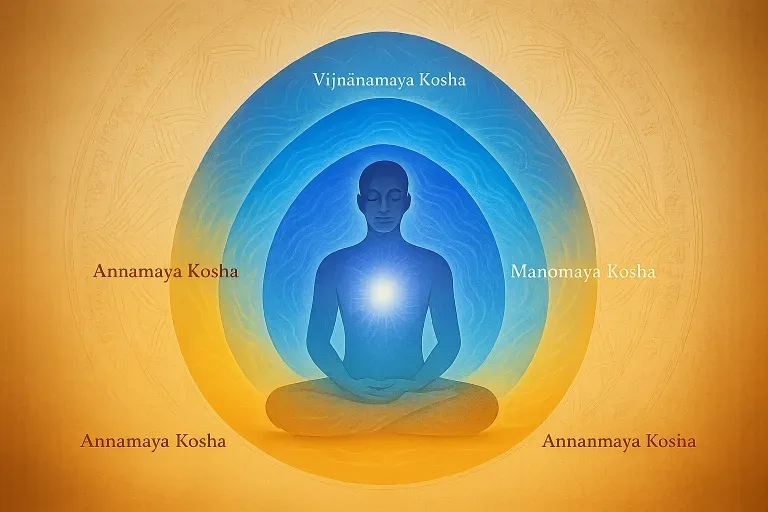
Most modern yoga practices focus on the Annamaya Kosha—the physical. But true Pranayama works with the Pranamaya Kosha, seeking to purify it so that deeper layers may shine through. This is not metaphorical. It is a felt, lived experience.
Vayus: The Movements of Prana
Prana, when it moves, is called Vayu—which literally means “wind.”
There are five primary Vayus that move through the body:
- Apana – Downward movement from the navel toward the pelvis.
- Samana – Sideways movement, stabilizing and digesting.
- Prana (Vayu) – Upward movement through the chest.
- Udana – Outward movement into the extremities and upward beyond the body.
- Vyana – Radiates in all directions, like sunlight spreading once the windows are opened.
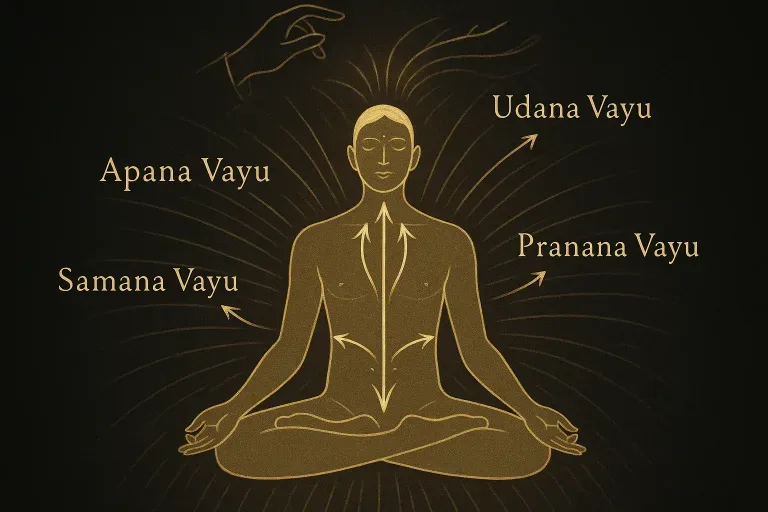
Vayus are not breath. They move with the rhythm of breath but are fundamentally different. I often compare them to an orchestra: the conductor’s arm (the breath) sets the tempo, but each instrument (the Vayus) plays its own part. You don’t breathe Apana. You feel it descend.
What Is the Purpose of Pranayama?
Pranayama is not about lung capacity or relaxation techniques. It is about purification—the cleansing of the Pranic body so that life may expand unobstructed.
Our Pranic body contains Nadis—subtle channels through which Prana flows. But these channels are often blocked by Malas, or clinging attachments. These aren't physical toxins. They are stuck energies, old stories, identifications with ego, unprocessed emotions—things that obstruct our full presence.
When these are cleared, Prana can move freely, especially into the central channel known as the Sushumna Nadi, opening the path to stillness (Unmani) and spiritual awakening (Siddhi).
Three Movements of Pranayama (Not Four!)
Modern teachings often speak of four parts to the breath: inhale, pause, exhale, pause. But classical texts like the Hatha Yoga Pradipika and Patanjali's Sutras describe three elements of Pranayama—not four:
- Puraka – The drawing in of Prana (not inhalation).
- Rechaka – The expanding out of Prana (not exhalation).
- Kumbhaka – The stillness that arises naturally after exhalation.
Kumbhaka is often misunderstood. It is not simply “breath retention.” True Kumbhaka is a place of stillness where Prana pauses, and Kundalini—the dormant spiritual energy—may begin to awaken. And there is only one Kumbhaka: after Rechaka. The idea of a pause after inhalation is a modern addition, not supported by ancient texts.
The Role of Asana and Daily Life
Pranayama does not exist in isolation. Our Asana practice can show us where the blockages are—where Malas cling in the Pranic body. Tight hips, stuck shoulders, pain in the back—these are signposts.
But the real practice begins when we take this awareness off the mat. I encourage you to:
- Place your awareness in the navel while walking.
- Feel Apana descending while waiting in line.
- Practice Agnisara or Kapalabhati to awaken the subtle perception of Vayu.
You don’t need perfect breath technique to begin. You simply need attention, presence, and a willingness to shift focus from the breath to the life that moves within.
The Need for a Sattvic Mind
Lastly, a word about the mind.
Without a clear, sattvic (balanced and luminous) mind, it becomes difficult to perceive Prana. This is why Pranayama and Raja Yoga are deeply linked. Both require inner purity—not moral dogma, but a lightness of being, a stillness that allows subtle movement to be felt.
A sattvic lifestyle helps, of course—clean food, a calm environment, conscious choices—but the essence of the practice is this: Pranayama is something you do, not something you study. Just like learning an instrument, it comes alive through repetition, humility, and practice, practice, practice.
I hope these words offer you a glimpse into the profound gift that is true Pranayama. It is not a technique to master but a sacred relationship to enter—one that unfolds over time, in silence, and in deep listening to the life within.
With love and deep respect,
Angela