About this article
Arunachala Hill — the silent guru of non-duality. Tiruvannamalai draws Vedanta seekers to Sri Ramanasramam, the ashram of Ramana Maharshi, and to a town where self-enquiry, temple worship and pilgrimage share the same landscape. This Ramanasramam visitor guide keeps the philosophical context of our original article and adds practical guidance for international travellers.
Quick facts for your first visit
Where: Tiruvannamalai, Tamil Nadu, at the foot of Arunachala. Arrival: Chennai and Bengaluru are the main airport gateways; allow several hours by road and confirm the journey with your driver. Entry: no ashram entry ticket. Main gate: 5:30 a.m.–8:30 p.m.; individual halls have breaks. Stays: online advance request for devotees, not walk-in tourist lodging. Dress: sleeved, loose clothing covering chest, shoulders and legs. Photography: prohibited under the published accommodation guidance. Season: October–March is generally more comfortable; plan for heat throughout the year.
Setting the Stage for a Spiritual Journey
Vedanta teaches that our deepest nature is not limited to the changing body and mind. In Advaita Vedanta, Brahman names the non-dual reality, while self-enquiry and contemplation turn attention towards awareness itself. You do not need to accept these teachings to visit respectfully, but knowing the terms helps explain why people return to Tiruvannamalai rather than treating it as a one-day sightseeing stop.
The town’s appeal is the opportunity to practise repeatedly: an early visit to a meditation hall, time with a book, a walk, and a return in the evening. For someone studying Vedanta, that rhythm can matter more than a long checklist. It is still a busy Indian town, with traffic, heat and festivals; do not expect every street or every day to be silent.
Arunachala: The Silent Guru and Manifestation of Shiva
At the heart of Tiruvannamalai rises Arunachala Hill, revered in Tamil Shaiva tradition as Shiva in the form of fire. The story of Shiva appearing as a column of light belongs to that tradition; it is not a geological claim. The Arunachaleswarar Temple represents the fire element in the Pancha Bhuta group of temples, rather than being one of the twelve Jyotirlinga temples.
Ramana spoke of Arunachala as the guru. Devotees often describe an inward pull towards the hill, but visitors need not feel anything extraordinary for their visit to be worthwhile. Sitting quietly, walking respectfully and noticing the landscape are enough. Girivalam, the circumambulation around the hill, is a separate activity from climbing to the hillside places where Ramana lived.
Ramana Maharshi: The Modern Sage of Self-Inquiry
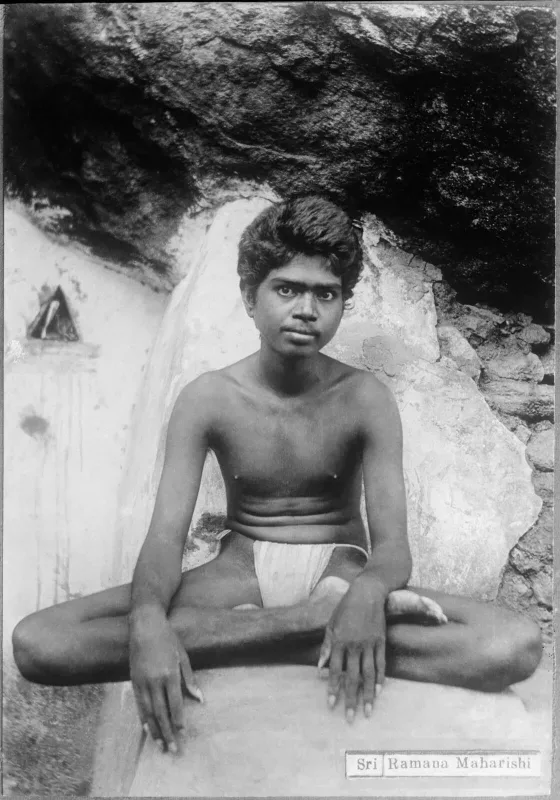
Bhagavan Sri Ramana Maharshi lived from 1879 to 1950. In 1896, at sixteen, he underwent the experience he later described as recognising the deathless Self. This happened in Madurai, before he travelled to Arunachala—not on the hill itself. He remained in Tiruvannamalai for the rest of his life, living first in temple precincts and on the hillside, then at what became Sri Ramanasramam.
His central instruction, “Who am I?”, is usually called self-enquiry or Atma-Vichara. It is not a request for a biography or an answer to repeat mechanically. The practice asks the seeker to examine the sense of “I” behind thoughts and experiences. Silence was an important part of his teaching, alongside conversations, written explanations and devotional hymns. You may also encounter the spelling Ramana Maharishi when searching; Ramana Maharshi is the ashram’s usual English spelling.
Why international Vedanta seekers come
Paul Brunton’s A Search in Secret India and Arthur Osborne’s writings helped introduce Ramana to readers outside India. Some visitors arrive through Papaji, who met Ramana, or through teachers such as Mooji whose teaching draws on Papaji. Others come through a book, a meditation group or their own study of Advaita. These connections explain the international community without implying that every contemporary teacher lives or teaches here.
Before travelling, consider Osborne’s Ramana Maharshi and the Path of Self-Knowledge, Ramana’s Who Am I?, or a selection of recorded conversations published by the ashram. Read slowly rather than trying to master the vocabulary. The bookshop offers an opportunity to continue that reading during your stay. No prior familiarity with Advaita is required for a respectful day visit.
Other Venerated Saints and Spiritual Lineages
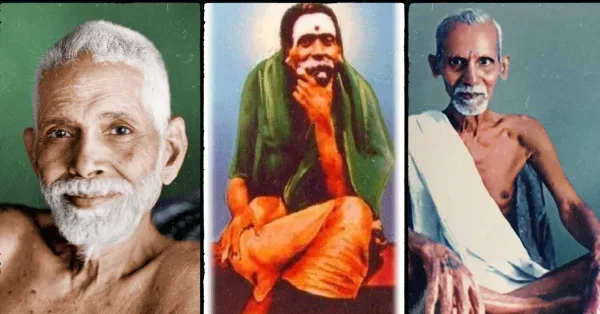
The original guide also introduced Seshadri Swamigal, Annamalai Swami and the wider Advaita community. Keep that context in view: Tiruvannamalai is not a single institution. Seshadri Swamigal is commemorated in his own ashram; Annamalai Swami was a close disciple of Ramana. Yogi Ramsuratkumar’s ashram offers another devotional setting in town. Check each institution’s own visitor arrangements rather than assuming Ramanasramam’s rules apply everywhere.
Nisargadatta Maharaj was based in Mumbai, not Tiruvannamalai, but I Am That remains influential among non-dual readers. Swami Sarvapriyananda’s Vedanta talks similarly offer context without making him a resident teacher here. Satsang teachers and meeting schedules change seasonally. Ask locally about current public sessions; do not book travel on the assumption that a particular teacher will be in town.

Inside Sri Ramanasramam: what to expect
The Old Hall
The Old Hall is associated with the years when Ramana received visitors and answered questions. Visitors often value its stillness, but it is a shared meditation space, not a performance or a guided attraction. Enter quietly, sit without obstructing others and silence your phone. Start with a short visit if long sitting is unfamiliar. Early morning is a practical option, but use the current gate and hall schedules rather than expecting access before the gates open.
The Samadhi Hall and the Mother’s shrine
The Samadhi Hall contains Ramana’s shrine, while the Mother’s shrine, also called Mathrubhuteswara, commemorates his mother. Vedic chanting and puja are part of the daily rhythm. You can observe respectfully without knowing the words or participating in every ritual. The published schedule lists an 8 a.m. Vedic chanting period and evening chanting from 5 p.m.; the Mother’s Shrine and Samadhi Hall close from 11 a.m. to 2 p.m. Special days can change the routine.
Grounds, books and meals
Allow time for the grounds and the bookshop instead of moving straight from one hall to another. Peacocks are often seen around the ashram; do not approach or feed wildlife. Ask the office about reading or library access rather than assuming every facility is open to casual visitors. The dining hall serves vegetarian South Indian meals to registered guests, residents and invitees—not automatically to every day visitor. Plan to eat at a nearby café or restaurant unless you have been invited.
Planning Your Visit to Tiruvannamalai — Practical Guide for Western Seekers
Getting There
Chennai is approximately 200 km from Tiruvannamalai; Bengaluru is another common gateway. Road journeys depend on the departure point, traffic, stops and conditions. Allow roughly half a day instead of relying on the original guide’s three-hour Chennai estimate or treating four hours from Bengaluru as guaranteed. Public buses connect the town with regional centres, and Tiruvannamalai is on the Villupuram–Katpadi rail line. Check actual services for your date before making onward connections.
Sri Ramanasramam is on the southwestern side of town, a short local transfer from the railway and bus stations. Agree the destination and fare before setting off, especially if arriving tired after an international flight. Keep your arrival day light. If you land late, consider resting before a long road journey rather than immediately starting an unfamiliar trip at night.
Where to Stay: nearby guesthouses or an approved ashram stay
The original guide’s advice remains useful: look for accommodation near Ramanasramam if repeated hall visits are your priority, rather than choosing only by distance to the commercial centre. Guesthouses and hotels vary in comfort and noise. Ask about air conditioning, water, stairs, road noise and walking access before booking. A room nearby gives you flexibility to rest between morning and evening visits without requiring ashram accommodation.
For an ashram stay, read the current official accommodation policy and use the online portal in advance. Accommodation is reserved for devotees deepening their study and practice of Ramana’s teachings. The policy explicitly excludes general temple visits, Girivalam trips and spiritual tourism as purposes for lodging. A guided tour does not change that eligibility.
Register through Sri Ramanasramam’s official stay portal. Activate your account, complete the required profile and submit your dates and purpose. Foreign nationals provide passport and visa information; OCI holders follow the foreign-national instructions. Submit identity documents only through the official process, not to an unsolicited booking agent. Phone, arrival-time and short-notice requests are not accepted under the published policy.
The dedicated accommodation page recommends at least three days and lists a maximum request duration of fourteen days for foreign nationals. Other overview text describes shorter usual stays, so do not treat the maximum as an entitlement or approval. Ask the ashram directly if you need clarification, and wait for written approval before relying on a room. Accommodation and meals for approved guests are free; voluntary donations are accepted. Keep a nearby lodging alternative in mind.
The Daily Rhythm, heat and pacing
The main gate is listed as opening at 5:30 a.m. and closing at 8:30 p.m. A realistic first day is an early ashram visit, breakfast outside if you are not an invited guest, and either quiet reading or a permitted cave visit. Return to your room before the hottest part of the day. Later, return for sitting, reading or evening chanting. There is no requirement to attend everything, and respecting the midday shrine closure is part of planning well.
Even the cooler season can feel hot to someone arriving from Europe or North America. Summer conditions can approach 40°C. Carry drinking water, use sun protection and allow more breaks than you would at home. A room with reliable cooling can be a practical help. If you feel unwell, stop, cool down and seek medical help when needed; do not reinterpret heat exhaustion, sleeplessness or distress as a spiritual achievement.
The Hill: Skandashram and Virupaksha Cave
Ramana lived at Virupaksha Cave and later at Skandashram before settling at the present ashram. They are hillside meditation sites reached on foot, not stops on the roadside Girivalam circuit. Ask the office about the permitted route and current conditions. The official accommodation page describes a 1.5 km climb and lists visiting hours of 8:30 a.m.–4:30 p.m. Plan the climb to arrive within those hours rather than expecting a cave meditation session at dawn.
Wear footwear suitable for an uneven, sometimes steep path and take water. Walking time varies with heat, fitness and pauses; do not make a fixed thirty-minute estimate the basis for a tight schedule. Ask about accessibility before attempting the route if you have mobility, balance or health concerns. Travellers report monkeys along the path: secure food and belongings, keep your distance and do not feed them. Walk with a companion or local guide where appropriate; the ashram advises women against walking unaccompanied on or around the hill.
Inside the caves, keep conversations short and voices low because others may be meditating. Follow instructions about footwear and photographs. The ashram warns that climbing beyond Skandashram and staying overnight on the hill or in the caves are prohibited. This visit is not a summit expedition. Conditions or access can change; accept a closure rather than looking for an unofficial way around it.
The Girivalam: walking around Arunachala
Girivalam, also called giripradakshina, is the roughly 14 km circumambulation around the base of Arunachala. It is largely a roadside pilgrimage route, not the climb to Virupaksha Cave or Skandashram. Devotees walk in a clockwise direction and visit shrines along the way, including the eight directional lingams. A steady walk can take several hours; temple stops, heat and crowds may make it longer than the original three-to-four-hour estimate.
For the devotional context, see the ashram’s Walking Around the Hill guidance. Choose a manageable stretch if the full circuit is too much. Some pilgrims walk barefoot, but do not assume that is suitable for you on hot roads. Consider your feet, health and traffic conditions, and seek local advice before starting. An early weekday walk is very different from a crowded full-moon pilgrimage.
Spiritual activities in and around Tiruvannamalai
The activities article added a broader view of the town, and that useful material belongs alongside the ashram visit. Arunachaleswarar, also called Annamalaiyar Temple, is the major town temple and the fire-element shrine. Its towers, courtyards and worship offer context for Arunachala beyond Ramana’s life. Check current public access, clothing requirements and photography restrictions locally; different parts of a temple can have different rules.
Seshadri Swamigal Ashram and Yogi Ramsuratkumar Ashram can be considered as separate visits, with their own devotional traditions and schedules. Leave time between them rather than promising that a single circuit covers every institution. For organised meditation retreats or courses, verify the actual centre, admissions process and dates with its operator. Do not assume that Sri Ramanasramam runs a bookable tourist retreat programme or that every retreat listing online is current.
The older activities guide also mentioned Gingee Fort, Parvathamalai and the Jawadhu Hills. They remain possible separate excursions, not extensions of the ashram grounds. Gingee is a heritage visit with substantial steps and exposed heat. Parvathamalai can involve demanding rocky sections and should not be presented as an easy alternative to the cave walk. For any out-of-town hill visit, confirm access, weather, transport and guide arrangements locally and leave a full day rather than squeezing it between meditation sessions.
Karthigai Deepam and full moons: crowds or quiet?
Full-moon nights attract large numbers of pilgrims for Girivalam. Karthigai Deepam, usually in November or December, centres on temple observances and the great flame lit on Arunachala. These occasions matter deeply to devotees, but they are not the quiet experience some first-time visitors imagine. Transport, rooms and walking routes can be affected. Confirm the year’s dates and local arrangements before booking, and reserve nearby lodging early.
If quiet sitting is your main purpose, choose ordinary weekdays outside major festival periods. If the festival itself is your reason for coming, allow extra time, expect crowds and follow police and temple instructions. The ashram’s accommodation guidance encourages devotees to avoid full moons and festival days when seeking a stay. Never assume a festival ticket, tour purchase or donation secures a room or special access.
How Long to Stay and Best Time to Visit
Three days is a useful minimum for a first visit: one day to settle into the ashram rhythm, another for permitted hill sites, and a third for the town or a manageable walk. A week lets you repeat quieter visits and rest rather than adding more attractions. Neither duration guarantees a breakthrough. Keep enough flexibility for heat, tiredness, closures and your own pace. The approved duration of any ashram stay remains the management’s decision.
October to March is generally a more comfortable planning window for outdoor visits. The original warning about the hottest months remains important, particularly for long walks in May and June. Rain can affect hillside paths during the monsoon period. Check the forecast and current local conditions rather than relying on a season label alone.
Practical Aspects for the Seeker: etiquette and honest expectations
Wear loose, sleeved, non-transparent clothes covering the chest, shoulders and legs. Shorts and beachwear are not appropriate. Leave shoes at the free shoe stall before entering the ashram; the official guidance also asks visitors not to carry footwear inside bags into the buildings. Keep phones silent and save conversations for outside the meditation and shrine halls. Follow the published prohibition on photography rather than assuming permission because other visitors are taking pictures.
Tiruvannamalai is not for everyone. If you want a spa retreat, a packed programme of classes or constant social activity, a contemplative ashram visit may disappoint. Some travellers describe deep stillness; others notice noise, fatigue or no particular feeling. You do not have to reproduce someone else’s experience. Smukti does not promise awakening, healing or a specific emotional outcome from a place, a teacher or a tour.
Going independently or with Smukti
You can arrange transport, book a nearby room and visit the public ashram areas yourself. A local host can help with arrival, realistic timing, language and permitted routes. Check what is actually included before booking, and distinguish help with planning from guaranteed entry, a teacher meeting or ashram lodging. Keep your attention on the purpose of your visit rather than the number of places covered.
You can visit independently. For help with transport, pacing and the places connected with Ramana, The Silent Guru – Arunachala & Tiruvannamalai is Smukti’s six-day / five-night guided journey. Check the current itinerary and availability on the tour page. Ashram accommodation, cave access and meetings are subject to the relevant authorities and local arrangements.
For the location and entity details, see Sri Ramanasramam on Smukti. This guide is the main practical article; the ashram listing remains a separate place page.
Frequently asked questions
Can foreigners visit Sri Ramanasramam?
Yes. Respectful visitors of any nationality or faith can visit without an entry ticket. Follow the ashram dress code, keep silence in the halls, and check current opening times before travelling.
How do international visitors request a stay at Ramanasramam?
Use the official stay.gururamana.org portal in advance. Accommodation is limited and reserved for devotees studying and practising Ramana’s teachings, not general spiritual tourism. Foreign visitors provide passport and visa details. A submitted request is not confirmation; wait for the ashram’s approval.
What are the ashram and cave opening hours?
The published daily schedule lists the main gate opening at 5:30 a.m. and closing at 8:30 p.m. The Mother’s Shrine and Samadhi Hall close from 11 a.m. to 2 p.m. Skandashram and Virupaksha Cave are listed as open from 8:30 a.m. to 4:30 p.m. Special-day schedules can change; check with the office.
What should I wear, and can I take photographs?
Wear loose, non-transparent clothing covering the chest, shoulders and legs, with sleeves and long trousers or an appropriate long skirt. Leave footwear at the shoe stall. The accommodation guidance prohibits photography within the ashram grounds; follow current signs and staff instructions.
How long should I stay, and when is the best season?
Allow at least three days to explore the ashram, the hill sites and the town without rushing; a week allows more rest and repeated meditation visits. October to March is generally easier for outdoor visits than the hottest months. Full moons and Karthigai Deepam bring much larger crowds and require early accommodation planning.
Is Girivalam the same as climbing to the caves?
No. Girivalam is the roughly 14 km circumambulation around the base of Arunachala, largely along roads. Virupaksha Cave and Skandashram are on the hillside and require a separate uphill walk. Do not plan either as a summit trek; the ashram warns against climbing beyond Skandashram.
Do I need to understand Advaita or book a tour before visiting?
No. You can visit independently and start with quiet sitting and reading. Advaita and self-enquiry provide context, but there is no test of prior knowledge. A guided stay can help with transport, pacing and local context; it does not guarantee ashram accommodation or a spiritual experience.
Official sources and last checked date
Official website guidance checked on 2 October 2026. This is a web-source check, not a claim of a recent host visit or telephone confirmation. Confirm accommodation approval, opening times, festivals and hill access directly before travelling. Guest quotations from the supplied draft have not been used because publication consent was not supplied.
Sri Ramanasramam: accommodation, registration, conduct and cave hours
Sri Ramanasramam: daily schedule and visitor dress code