About this article
Most first-time visitors worry about how they'll be treated in India. The honest answer is: with a lot of curiosity, a lot of warmth, and occasionally more attention than you're used to.
We recently read through more than 200 comments on a popular vlog of a foreign mother and her young son exploring a Mumbai street food court. The overwhelming tone was pride and affection. Viewers thanked her for coming with an open mind, welcomed her son to India, and cheered the locals who went out of their way to make her feel at home. One commenter who spends six months of every year in India said simply that they love it. Another, a longtime visitor, wrote that most Indian people are genuinely friendly.
The travelers who join our IndiaCalling podcast say the same. A New Zealander who has spent more than three decades in India describes the country as one big parivar (family), where everybody is ready to say hello and every rickshaw driver is ready to give you satsang (spiritual conversation). An American guest said some of the times she has felt safest and most welcomed were in India.
This guide explains what that warmth looks like on the ground, and how to respond to it gracefully.
Why Indians Are So Curious About You
Many people rarely meet foreigners in person. India receives millions of international visitors, but that's a tiny number for a country of 1.4 billion. Outside big tourist hubs, you may be the first foreigner someone has spoken to. Curiosity is natural.
Staring is not hostility. Looking openly at something interesting isn't considered rude in most of India. A long look is usually followed by a smile if you smile first.
A Dutch traveler learned this late one night at a Delhi railway station. Her friend was putting in a contact lens, and a crowd of men gathered to watch, which felt intimidating. A local man stepped in and reassured them: don't worry, they're just curious. He turned out to live in Varanasi, and later showed them around his city. She says she has had meetings like this everywhere in India.
People want you to like their country. Indians are deeply proud of their food, festivals and faith, and many are anxious about how India is shown abroad. In the comments we read, viewers repeatedly praised travelers who showed India fairly, without exaggerating the chaos. When you show genuine interest, people light up.
Selfie Requests and Attention
At temples, beaches and monuments, expect to be asked for photos. Sometimes it's one shy teenager; sometimes it's a whole family, grandmother included.
If you're happy to say yes: smile, pose, and ask where they're from. It's one of the easiest ways to make a local friend, and many travelers end up treasuring these moments.
It can be a lot, though. A Swiss retreat leader takes her groups from Rishikesh to Haridwar, where few foreigners go. Within minutes, a line forms for photos. At first her guests love feeling famous. After two hours, she says, they're asking to go back to Rishikesh. A six-foot-five Australian guest says he gets photographed everywhere, and that people rarely forget you once they've met you.
If you'd rather not: a smile, a gentle head shake and "no photo, please" is completely acceptable. You don't owe anyone an explanation.
Useful boundaries:
Set a limit early: "Just one, then I have to go." Once one photo happens, a queue often forms.
Women traveling alone can decline photos with groups of men without guilt. Stay near families or other women in crowds. See our safety guide for women traveling in India.
Offer a handshake or namaste instead of arms around shoulders if you prefer less contact.
Ask before photographing people yourself. It's the same courtesy you'd want.
One of our Polish guests is honest that not every encounter is kind. On a night bus in the north, a man kept touching her and wouldn't stop. She no longer takes night buses alone, and she recommends long, loose clothing to avoid unwanted attention. But she also noticed something else: people around her, especially women, stepped in and helped.
Hospitality: Chai, Food and Invitations Home
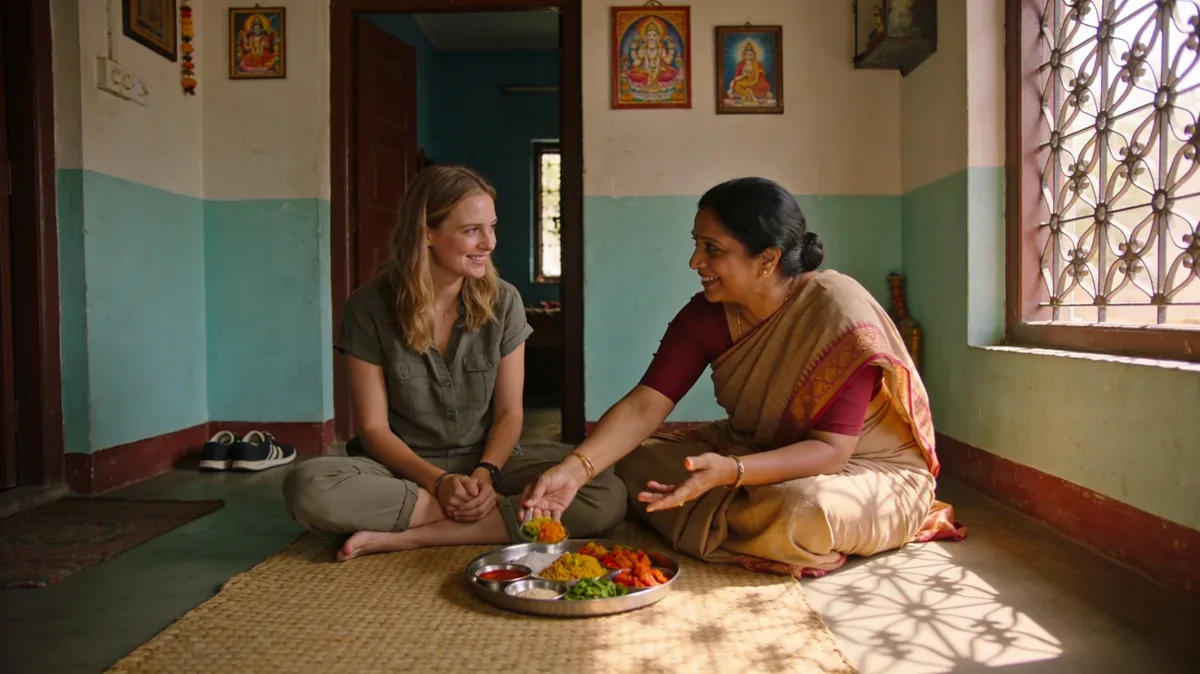
This is the side of India that surprises visitors most. Strangers will offer you food on trains, shopkeepers will pour you chai, and a conversation at a temple can end with an invitation to someone's home.
In Rishikesh, a Swiss guest's teacher took her by scooter to his favourite street stall. An elderly man there invited them into his tiny pink-walled room, with pictures of Durga, Sita and Ram on the wall, and made them chai. She still remembers the care he put into every step, and how touching it was to be handed that cup.
Some invitations last a lifetime. The Swiss retreat leader met a group of cousins from a large Jain family in Rishikesh and, in her words, got adopted. She has since traveled with them across Chennai, Ooty, Bangalore and Rajasthan and attended their family weddings.
Accepting food and chai
Accept with your right hand, or both hands for something offered with ceremony.
A polite first refusal is normal, and hosts will insist. If you want it, the second offer is your cue to accept.
You'll be offered seconds, and thirds. Leave a little on your plate or say bas ("enough") with a hand over your plate.
It's fine to decline food on long journeys from people you've just met. Accept packaged snacks or chai made in front of you.
If you're invited home
Remove your shoes at the door. Watch what your hosts do.
Bring a small gift: sweets from a local shop, fruit, or something from your home country. Avoid alcohol unless you know the family well.
Greet elders first. A namaste with a slight bow goes a long way.
Expect to be fed generously, and possibly served before your hosts eat.
Questions that feel personal
Are you married? How many children? What's your job, and how much do you earn? Why aren't you vegetarian? In India, these are friendly ways of getting to know you, not intrusions. Answer as much as you're comfortable with, and feel free to ask the same questions back.
Language mix-ups are part of the fun. In the vlog we watched, the traveler asked for "dessert" and was served misal pav, a spicy lentil curry. Indian viewers explained that in India you ask for something sweet. Small moments like this often become the best stories. Our guide to overcoming language barriers has more phrases that help.
Traveling with Children
Indians adore children. In the vlog's comments, the traveler's little son drew almost as much love as the food, with viewers from all over the country sending him blessings. Expect strangers to smile at your child, offer sweets, pinch cheeks, or ask to hold them.
It comes from affection, but you're still the parent. It's fine to say "he's a bit shy" and keep your child close. Politely decline sweets if you're managing what they eat, and carry wipes for sticky hands after all the blessings.
A Slovenian guest first brought her daughter to India at age three. The little girl was overwhelmed at first, then fell in love with everything she saw. Now 26, she keeps asking when they can go back.
Kindness vs Scams
The vast majority of help you'll receive is genuine. A few simple checks help you tell the difference:
When kindness is real. The day after Shivaratri in Varanasi, a Polish guest left her only bank card in an ATM. A local man found her on Facebook, and when she didn't see his message, his friend reached her on Instagram. They returned the card the next day and refused any money as thanks.
When it isn't. At the Varanasi cremation ghats, a man approached the Swiss retreat leader, then traveling alone, and told her fascinating stories. Then he asked for money. When she gave some, he pushed for more by asking whether she was building good karma. That was her signal. Kindness never needs to invoke your karma to get paid.
Stay open, but use discernment. Another guest on a Varanasi retreat was invited by an astrologer to his ashram near the Durga temple. The group almost said no because they didn't know him. They went, and he performed a beautiful Kali puja for them. Her advice is to stay a little spontaneous. The Swiss retreat leader adds a balancing note: don't take an invitation from a random stranger lightly, especially when traveling alone. Go with others, go in daylight, and trust your gut.
Genuine kindness asks for nothing. A person who walks you to a bus stop and waves goodbye is being kind. A person who walks you to their cousin's shop is not.
Be wary of "your hotel is closed" or "the temple is shut today." These are classic ways to redirect you.
Ask two or three people for directions. Some people would rather give a confident guess than say they don't know.
Read our full guide to scams to avoid in India before you go.
How to Be a Guest People Remember
The travelers Indians talk about warmly all do a few things well:
Come with an open mind. Commenters repeatedly praised travelers who arrive without prejudice and see India for themselves.
Join in. Eat with your hands, try the street food, join the aarti. Here's how to eat with your hands.
Learn five words: namaste (hello), dhanyavaad (thank you), bahut accha (very good), bas (enough), and kitna (how much).
Show the real India. If you share photos or videos, show the beauty along with the chaos. People notice, and they're grateful.
Dress for respect in sacred places. Covered shoulders and knees at temples and ashrams. See our 20 tips for visiting temples.
A guide who lives in Varanasi and leads visiting groups has three reminders for newcomers:
You're an ambassador. For the most part, people here are simply excited to meet you. How you behave shapes how they see your country.
A little effort goes a long way. Even a warm "namaste ji" is appreciated, and nobody will judge you for mispronouncing it.
Bring something of yourself, not money. Come intending to connect heart to heart.
She also tells a story about a misunderstanding. During an evening aarti on the ghats, a visiting woman felt a priest was being rude when he told her to move her legs. In fact, the aisle has to stay clear for the ritual, and she had seen him ask men to do the same many times. When something feels personal, it usually isn't. As she puts it, the moment is about the greater spiritual energy everyone is connecting to.
The Spiritual Root of Indian Hospitality
Two old Sanskrit ideas explain much of what you'll experience.
Atithi Devo Bhava means "the guest is God." It comes from the Taittiriya Upanishad, and it is still taught to Indian children. A guest who arrives unannounced is traditionally treated as a visit from the divine.
Vasudhaiva Kutumbakam means "the world is one family." At Smukti, this idea is at the heart of why we do what we do. In Indian philosophy, your soul (Atman) and the universal spirit (Brahman) are the same. Many people treat strangers with kindness because they see the divine in everyone.
You won't learn that from a book. You learn it when a stranger on a train insists you share their lunch, or a temple priest's family invites you in for chai. Many of our guests say these moments stayed with them longer than any monument.
An American guest experienced this at the Ujjain Kumbh Mela. After an unpleasant stay at one ashram, she was called into a camp of Naga sadhus. Within a minute she had chai, and an offer of food and a place to sleep. When her travel companion left, the sadhus kept her close to keep her safe, as the only foreign woman there.
Sometimes the kindness feels almost mystical. During a fire ritual at Badrinath, an Australian guest's group was handed ghee lamps by a woman in a blue sari who refused any payment and then seemed to vanish. When he asked the priest who she was, the priest smiled and answered: Lakshmi.
"I realized that my understanding of poverty is very, very different. These people are richer than any of us." — a traveler from Ireland
Many guests say India changed how they see themselves. Watching a family walk down to the Ganga every morning in Rishikesh to greet the sun, that same Australian guest remembers thinking all his priorities in life were wrong.
FAQ
Are Indians friendly to foreigners? Yes, overwhelmingly. Expect curiosity, generosity and plenty of questions. Normal travel caution still applies in crowded tourist areas.
Why do people in India ask foreigners for selfies? Mostly curiosity and friendliness. For many people, especially from smaller towns, meeting a foreign traveler is memorable. You're free to say yes or no.
Is it safe to accept food from strangers in India? From families and in homes, generally yes. On long journeys with people you've just met, it's wise to accept only packaged snacks or freshly made chai.
How do I politely refuse more food? Place your hand over your plate and say bas or "enough, thank you." You may need to say it twice.
Travel India as a Guest, Not a Tourist
Smukti journeys are built around these encounters: meals with local families, time with temple communities, and hosts who help you navigate the culture. Explore our spiritual tours.