About this article
In a popular YouTube vlog from a Mumbai street food court, a foreign traveler scoops up her food with her fingers while a friendly local uncle, trying to make her feel at home, eats his samosa with a spoon and fork. The top comment on that moment has more than 7,000 likes. Indian viewers loved it, and many wrote some version of "finally, a foreigner who knows how to eat Indian food."
That tells you something useful before you land. Eating with your hands is not a quaint habit Indians expect you to avoid. It is a small act of respect that people notice and warmly appreciate. This guide shows you how to do it well, and why it matters.
Our own hosts have lived this. A Swiss retreat leader who now brings groups to India every year remembers her first trip. After a 17-hour train ride to Chennai with nothing to eat, she bought a coconut outside the station. When the vendor cut her a piece of shell to scoop out the soft flesh, she refused it and pulled out the spoon she carried everywhere, terrified of "Delhi Belly." Everyone around her burst out laughing. Today she eats with her fingers without a second thought, and she briefs every group she brings on how to do it.
Why Indians Eat with Their Hands
For most of India, hands are the original cutlery. Across homes, temples, ashrams and roadside stalls, eating with your fingers is normal, clean and often preferred. There are three reasons behind it.
It is how Ayurveda says food should meet the body. Ayurveda links each finger to one of the five elements (earth, water, fire, air and space). Touching food with all five brings those elements together before the first bite. Your fingertips also sense temperature and texture, so you eat more slowly and mindfully. Ayurveda teaches that digestion begins before food reaches the mouth.
"It's about using all your senses when you eat. You're truly nourishing yourself with all the elements, and all the elements are also in your fingers." — a Dutch traveler who married into an Indian family
She adds a point many Westerners never consider. Back home, people told her eating with your hands was dirty. Her answer: what's really unhygienic is walking into the house in the same shoes you wore outside.
Food is sacred, not just fuel. An old Upanishadic teaching says annam brahma: food is a form of the divine. In temples, food is first offered to the deity and then returned to devotees as prasad, a blessing you receive in your right palm. At Smukti, we often see guests change the moment they understand this. A meal stops being a transaction and becomes a quiet exchange of gratitude.
You'll see this reverence in unexpected places. A traveler from Ireland, waiting at a small local café, noticed the cook quietly praying over each plate in the kitchen before bringing it out, with no one watching. It showed her how sincerely people live these practices, even behind closed doors. An American guest put it simply: the way people pray over food before eating means spirituality is built into the day.
It is an act of closeness. In Indian homes, a mother mixes rice for her child with her own hand, and friends share from each other's plates. Eating with your hands tells your hosts you are not keeping them at a distance. As we describe in our founding story, you don't learn unity by reading about it; you learn it at a shared table.
The Golden Rules
Get these five right and you will eat more gracefully than most first-time visitors.
Eat with your right hand only. The left hand is traditionally used for bathroom hygiene, so it never touches food going into your mouth. This matters even if you are left-handed.
Your left hand still has jobs. Use it to hold a glass, pass a dish, tear a stubborn roti with the help of your right, or take a serving spoon from a shared bowl.
Wash before and after. Every restaurant, ashram and home will have a basin, often in the dining area itself. Washing after the meal is as normal as washing before.
Never put your eating hand into a shared dish. Once food touches your mouth or plate, it is jootha (touched and no longer shareable). Use the serving spoon for common dishes, and don't offer anyone food from your own plate unless they are family-close.
Keep it on your fingertips. Food should stay below your second knuckle. Your palm stays clean. This is the difference between eating with your hands and eating messily, and Indians notice.
Step by Step: How to Actually Do It
South Indian rice meals
This is the one most visitors find hardest, and the most rewarding once it clicks.
Take a small amount of rice onto your side of the plate or leaf.
Pour a little sambar, rasam or curry over it and mix with your fingertips until it clumps.
Gather a bite-sized portion with four fingers, forming a loose ball.
Lift it to your mouth and use the back of your thumb to push it gently in. Your fingers never go inside your mouth.
Mix only one portion at a time. The rest of the rice stays dry and ready for the next dish.
North Indian roti, naan and paratha
Hold the bread down with your index and middle fingers.
Tear a small piece using your thumb and fingers, all with your right hand. This takes practice, so it's fine to steady it with your left.
Fold the piece into a little scoop and pinch up dal, vegetables or paneer with it.
Eat the scoop and the food together in one bite.
Street food
Pav bhaji and vada pav: tear the soft bun (pav) and use it to scoop the bhaji, or eat vada pav like a sandwich.
Pani puri / golgappa: the vendor hands you one at a time. Eat each in a single bite, immediately, before it goes soggy.
Dosa: tear from the edge, fold a piece around the filling, and dip it in chutney.
Samosa: break it in half with your fingers and dip it in chutney. No spoon and fork needed, whatever that uncle in the video might suggest.
Banana Leaf Meals, Ashrams and Temples
On Smukti's South India journeys, many of the most memorable meals are served on a banana leaf, often sitting cross-legged on the floor in a temple dining hall or ashram.
Banana leaf etiquette
The narrow tip of the leaf points to your left. Servers move down the line, placing each dish in its traditional spot.
Sprinkle a little water on the leaf to rinse it before food arrives, if others do.
Servers will keep refilling. To say "enough," cover the leaf with your right hand or say bas (Hindi) or podhum (Tamil).
When you finish, fold the top half of the leaf toward you. In Tamil Nadu and Kerala, this signals you enjoyed the meal.
Eating at an ashram or temple
Many ashrams eat in silence. Treat the meal as meditation: slow, grateful and present.
Take only what you will finish. Wasting food in a sacred space is considered disrespectful to the offering.
Receive prasad with your right hand, cupped over your left, and eat it rather than throwing it away. At temples such as Amritapuri, this simple gesture opens many warm conversations with locals.
Some ashrams begin meals with a short chant of gratitude. You don't need to know the words; sitting quietly is enough.
Indian tradition also ties what and when you eat to the rhythms of the sun, moon and seasons. Ayurveda recommends your largest meal at noon, when digestive fire (agni) peaks with the sun. You'll see this in ashram schedules: a generous lunch and a light, early dinner.
Ashram food is usually sattvic: simple, fresh and lightly spiced, prepared to calm the mind. As one of our Irish guests warns new retreat-goers, it's plain food, not there to entertain you but to feed your body. A Spanish guest found the opposite of deprivation. Between sattvic meals and her own Mediterranean habits, she felt better than ever, and learned to eat despacio, slowly.
Free kitchens: food as seva
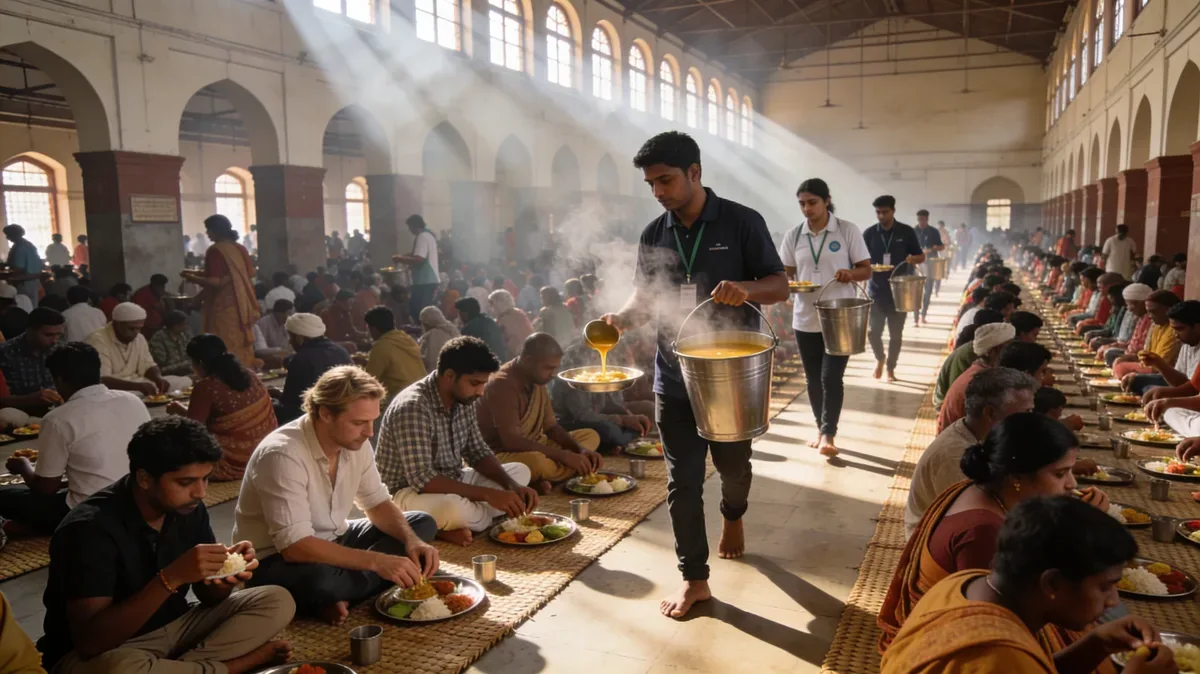
India's greatest meals are often free. At the Golden Temple in Amritsar, the Sikh community kitchen (langar) feeds anyone who walks in, whatever their faith. A Dutch guest who visited described how anyone could come in and be nourished, both by the food and by a stillness she found mesmerizing. Many South Indian temples serve free meals (annadanam) the same way. Neem Karoli Baba's famous instruction to his devotees was simply to feed people and love everyone. Sitting in one of these halls is the clearest way to understand why food in India is sacred.
What Travelers Wish They'd Known
On our IndiaCalling podcast, international travelers who've spent months and years in India shared what they'd tell a first-timer about food:
You won't lose weight. Many visitors expect to, and it's usually the opposite. A British guest said everybody wants to feed you the whole time. The Swiss retreat leader gained about six kilos on her first trip because every host insisted on feeding her, and she learned that, for many families, welcoming a guest without food is simply impossible. Her compromise now: "just fruit, please."
Pace yourself with thalis. An Italian guest found her first and second thalis delicious, but by the third her stomach wasn't ready for so many new dishes. Eat a little less for the first few days.
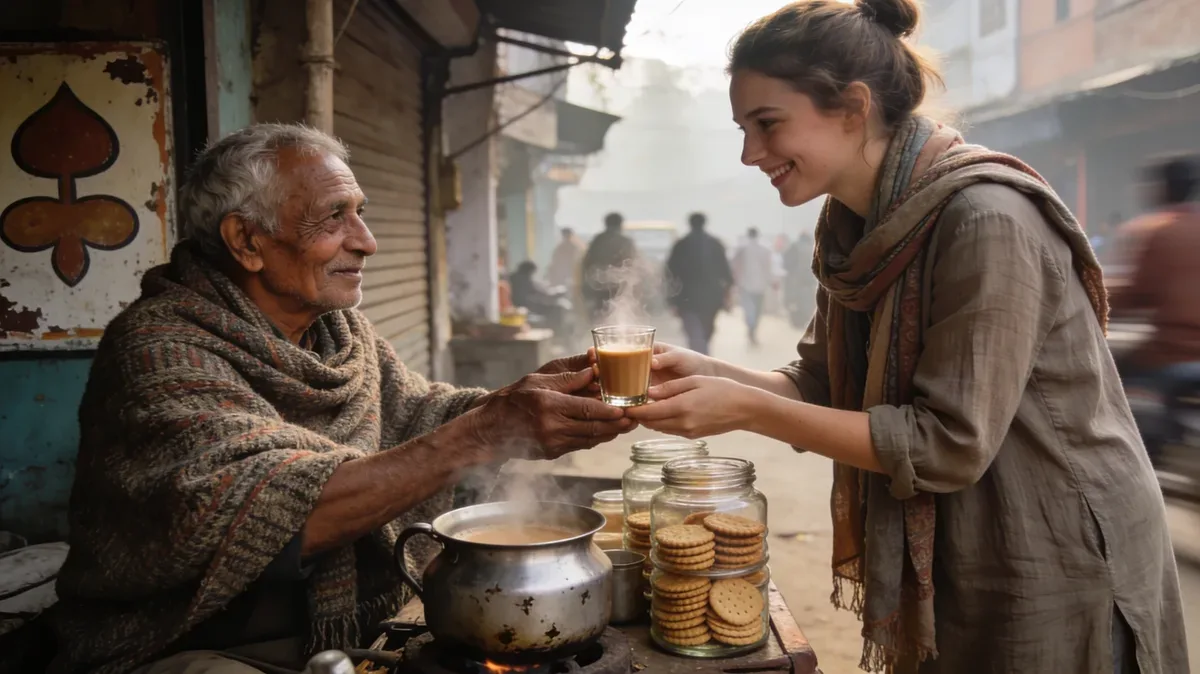
Street chai is the exception. Several guests avoid street food in general, but every one of them makes an exception for chai. As one Australian put it, street chai is the best chai.
Trust your instincts. If a place doesn't feel right, don't eat there just to be polite. Choose places that look clean and busy.
Go vegetarian. It's easier, safer, and India has some of the best vegetarian food in the world.
Eat by the sun. Follow the Ayurvedic rhythm: breakfast in the morning, your main meal between about noon and 2pm, and a light supper, ideally before 6pm.
Don't believe the viral videos. A Spanish guest's friends sent her clips of "dirty" Indian street food before her trip. She points out that the worst kitchen in any country could go viral. Her real experience was very different.
Leave the protein bars at home. An American traveler noticed guests always pack a box of snacks "just in case," then give it away by the end of the trip because the food is so good.
When a Spoon Is Perfectly Fine
Nobody will be offended if you use cutlery. Most restaurants will bring a spoon if you ask, and many Indians use one for rice, dal or desserts. Hotels and upscale restaurants set tables with cutlery by default.
Use your hands where it feels natural (homes, ashrams, banana leaf meals, street food), and a spoon where it's the norm or you're not comfortable. The effort matters more than perfection.
Hygiene tips
Carry a small hand sanitizer for street stalls without a basin, and a pack of tissues.
Keep nails short for your trip. It makes eating with your hands far more pleasant.
Choose busy stalls where food is cooked fresh and hot in front of you.
For more, see our guide on how to avoid getting sick in India.
Even seasoned travelers sometimes get sick. A British guest who has visited India many times fell ill after a wedding and spent time on a drip in a government hospital. Her takeaway: it can happen to anybody, it's fixable, and the care she received was excellent. Travel insurance and a calm attitude go a long way.
FAQ
Is it rude to eat with a fork in India? No. It's accepted everywhere. But eating with your right hand at a home, temple or ashram is appreciated as a sign of respect.
I'm left-handed. What should I do? Eat with your right hand in traditional settings, even if it's slow at first. In cafes and hotels, nobody will mind.
Do Indians lick their fingers? At home, some do, to show they enjoyed the meal. In public, it's better to simply wash your hands.
What if I make a mess? You will, and it's fine. Most hosts will happily show you how. It's one of the quickest ways to start a conversation in India.
Come Eat with Us
On Smukti journeys, you'll share banana leaf meals in temple halls, eat in silence at ashrams, and sit down with families who keep these traditions alive. Explore our Spiritual Journey through Southern India or the Amma Yatra to Amritapuri.